Feb. 19th, 2011:
In Japan, certain flowers' blossoming season are very famous with these times being watched and waited for, and people spending their time going to popular spots to see the blossoms. Obviously, the cherry blossom season or Hanami is the most famous of the blossoming seasons, known world wide and in Japan, its most popular blossoming season. However, a long time ago Hanami was not Japan's most popular or important blossoming season. This spot was held by the first blossoms of spring from the ume (梅) (really a Japanese Apricot, but commonly translated as plum).
The ume tree blossoms in February, the earliest of all the blossoming trees in Japan and lasts until early to mid-March. It leaves right before the cherry trees bloom. Ume blossoms are different shades of white, purple, pink and red, and are most well known for their strong, pleasant fragrance. During the Nara Period (710-794), ume blossoms were the most important viewing. Cherry blossom viewings became more important into the Heian Period (794-1185), and have been ever since. This favoring of the ume blossom is recorded in
The Tale of Genji (Genji Monogatari, 源氏物語), a famous novel written in the Heian Period by Shikibu Murasaki. The Tale of Genji is one of Japan's most important literary works and considered to be the world's first written novel.
Lady Murasaki was a nobelwoman at the Imperial Palace in Kyoto during this period. While unallowed to write in Kanji (漢字) (Chinese characters used in Japanese language) used in court life, because it was thought to be too strenuous to learn for a woman; she wrote The Tale of Genji in Hiragana (Japan's native written language) over the course of years during her time free from court responsibilities. The Tale of Genji is actually broken up into 6 seperate books that tell the story of Genji, who is an adopted prince by the Emperor. My personal thoughts on this classic are that in the first two books the female characters are too shallow and only focus on the adoration for Genji (Japanese Prince Charming in every way) which makes the books a bit slow and shallow, as these two books mainly follow Genji's love interests and Genji himself. The 3rd and 4th books are the great ones, where Genji has matured, characters are much deeper and the story of their lives and life at the palace are enjoyable. The last 100 pages of book 4 are especially good, with many twists and turns in the plot. After the quality in books 3 and 4, books 5 and 6 are even more disappointing as all of the characters were unlikeable to me personally. However, reading a translated version and not understanding the myriad of references in the book (most based on Ancient Chinese or Japanese literature), as well as a full understanding of Heian court life, I might not be fully grasping the author's intention with certain characters or plot.
In this book, Lady Murasaki describes why the ume blossom was more important than the cherry blossom with,
""How pleasant it would be if all flowers had so delightful a scent as this." However it is a good thing for the other flowers that the cherry blossom can not borrow this smell. The rest would seem to us mere weeds, and we should never give them another thought again. The plum-flower, however has this advantage over the others, that it comes first. Our eyes have not been sated with blossom, and we accord to this earliest comer what is perhaps an undue attention. Then wisely, it vanishes, before the cherry has reached its prime..." [1]
This passage not only provides the reasoning for its top status at the time, but also foretells of its decline in status, as the cherry blossom viewing would surpass the ume. Even while not as popular now, the famous spots for ume are still crowded during this season with people out to enjoy them. Koishikawa Kōrakuen (小石川後楽園) is one of the most famous ume spots in Tokyo.
Koishikawa Kōrakuen is not only one of the most important gardens in Tokyo, but of all of Japan. Koishikawa Kōrakuen is designated as an important historical asset and a site of special historic significance. In Japan, there are only 7 places that have both designations, which are some of the most famous sites in Japan. They are Kinkakuji, Ginkakuji, Sampo-in of Dogoji, Nibo-no-miya in Heijō-kyō, Itsukushima Shrine, Hama-rikyū and Koishikawa Kōrakuen. [2] The park was built in 1629 by the founder of the Mito Tokugawa family, Yorifusa which had a separate residence than the rest of the Tokugawas here. The gardens would not be finished until the 2nd ruler Mitsukuni. [3] Some of the most interesting features of the garden are the Chinese concepts and elements added under the guidance of the Confucian scholar refugee from Ming China, Shushunsui. These include the reproduction of Seiko Lake from China and a Full Moon Bridge. [4]
The Kōrakuen name for the garden refers to the Chinese text Gakuyoro-ki by Hanchuen, which contains a line admired by Mitsukuni saying, "a need for those in power to worry about maintaining power first and then enjoy power later." Kōrakuen (後楽園) means, 'the garden for enjoying power later on.' [5]
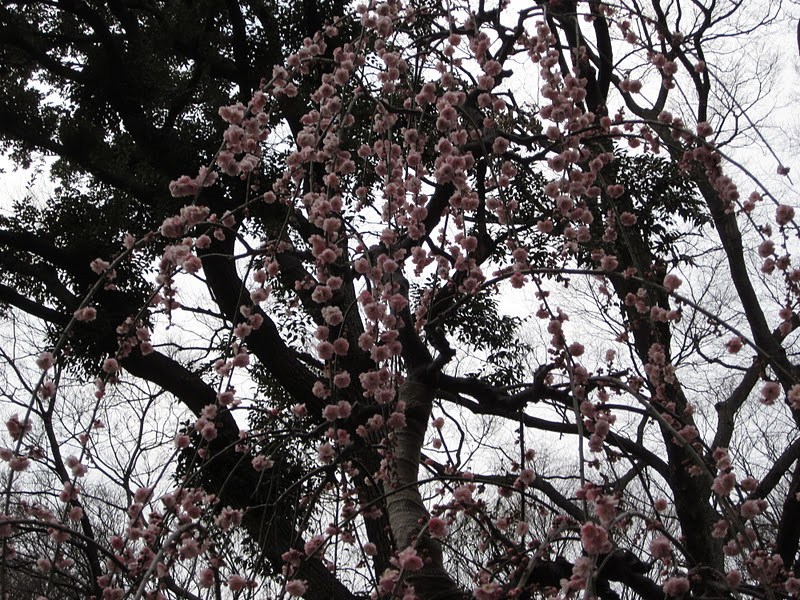
The garden costs 300 yen to enter. After paying and entering, we decided to go see the ume blossoms that we came to see first. The northeast far end of the park is where the main grove of ume trees are. The long drooping branches are convered in delicate flowers of the white, purple, pink and red shades. Walking towards the trees, the nose fills with the pleasant fragrance of the ume blossoms. Like walking through the finest of perfume stores.
We got to the park just a little bit before peak season. These are what the trees look like about a week or two before peak blossoming.
Here's a more detailed look at the blossoms themselves:
The ume blossoms weren't the only thing to see in the park though. The park, while shruken from its glory days, still boasts an impressive size and there is plenty more to see.
 |
| The map to Koishikawa Kōrakuen. [6] |
 |
| The hills you'll see right after the main entrance of the park. |
 |
| Actually, the park is right in front of the Tokyo Dome. The Tokyo Dome is the home park of the Yomiuri Giants, basically the New York Yankees of Japanese baseball. The dome can be seen peering over the trees at the park. |
 |
| As you might have noticed in the previous picture, this tree has a variety of ropes strung around it. This is a common way to protect the tree from winter snow. Many trees here are grown to have long extended branches, so during the winter these are set up to help support the branches from the weight of the snow. |
The tree in the previous picture is called Hitotsu-matsu (一つ松). The meaning behind the name is the pond here represents Lake Biwa, the largest lake in Japan and this tree represents a famous tree off the coast of Lake Biwa.
 |
| The Furo-no-Mizu (不老の水) Well in the park. |
 |
| The building is the Kuhachi-ya (九八屋). A model sake house that would have existed in the Edo Era. Like much of the park, the original was lost in the air raids of 1945, but was rebuilt in 1959. |
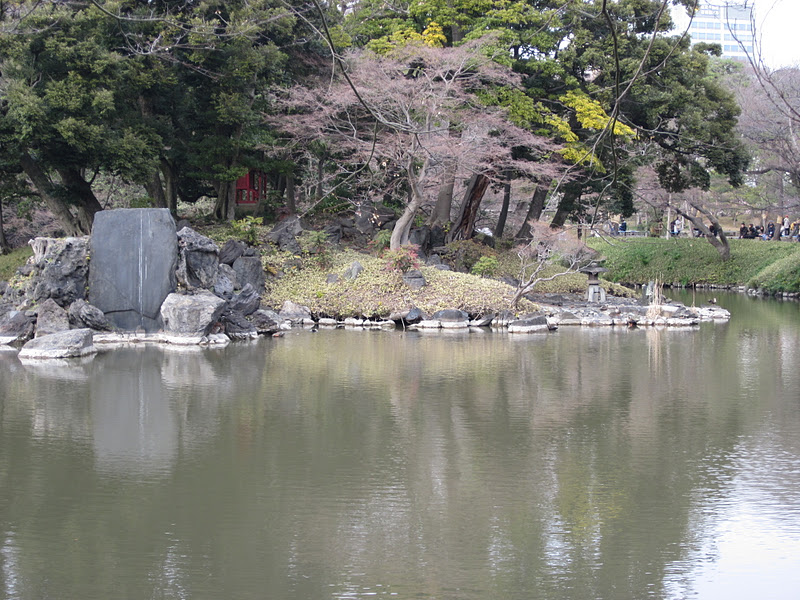
We decided to have lunch in this area, as it had a nice overlook of the pond. There is an island in the middle of the pond called Horaijima (蓬莱島).
 |
| I talked about Benten in my posts on Enoshima. |
 |
| The Tokudaiji (徳大寺) Stone to the left. |
The pond also has a small channel connected to it which used to be the boat launching point when it was still a private garden.
 |
| Now just a popular hang-out for ducks looking for food from people passing by. |
After this area and heading towards Naitei on the east side of the pond has some nice views.
 |
| Naitei with Tokyo Dome in the background. Naitei (内庭) means inner court, so this was the inner garden for the Mito Tokugawa Clan. This used to be separated from the main garden by a gate, but this was also lost during the war. |
 |
| The main gate is also in this area, but it is no longer in use. |
 |
| The wooden supports are common on many trees in Japan. |
 |
| This is all that remains of the gate for the inner garden. |
 |
| "In this site, there used to be a gate of the entrance of "Korakuen" garden. It was a gorgeous gate with colorfully lacquered carvings in Chinese stle. A wooden plate with the name of the garden, Korakuen, written by Chu Shun Shui was hund over the gate, all of which was lost in the air raids in 1945." |
Almost back at the beginning of the park is Saigyo-do (西行堂).
 |
| "Yorifusa, the 1st lord of Mito-Tokugawa family, built this small shrine to niche the statue of Saigyo. The monument inscribed with a poem of Saigyo was erected by the wife of the 9th lord. The shrine was burnt down during the air raids in 1945." |
At this point we had finished the inner loop of the park and were back at the beginning. There was still the outer loop to see as we went straight to the ume blossoms on the inner loop the first time. The outer loop has some of the more interesting in-tact buildings in the garden. The first sight along the trail is the Byobu-iwa (屏風岩)
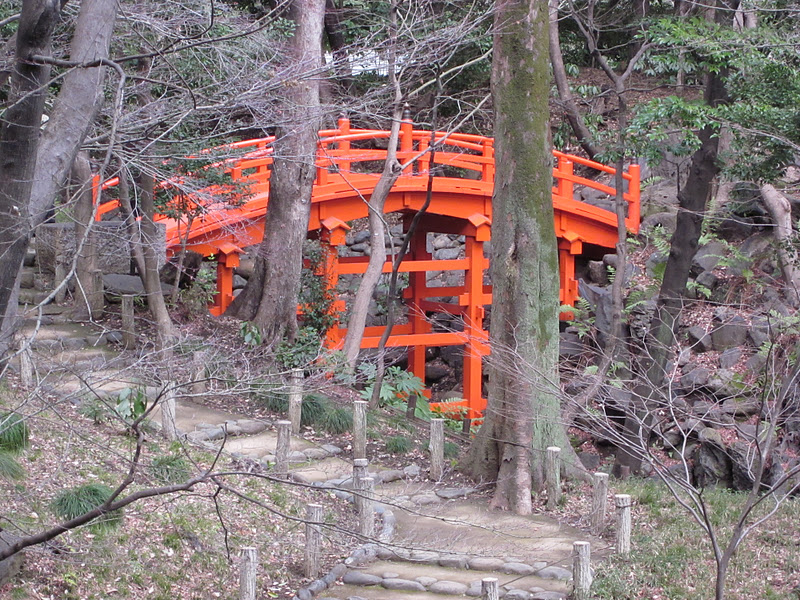
This area is near a small stream where it is easy to see the next area on the loop, the bridge, Tsutenkyo (通天橋).
 |
| The view of Tsutenkyo near Byobu-iwa. |
 |
| Further along on the path. |
 |
| The view below while on Tsutenkyo. |
Here is the view of the bridge from that stone walkway in the picture above:
Right before the bridge is the site of a temple that has also been lost. It also would have been an impressive sight from down below, but the little that remains of it now isn't very visible until close. The temple was Kiyomizu Kannon-do (清水観音堂).
 |
| "There used to be a temple to niche a statue of Kannon or Goddess of Mercy. It imitated a building found in Kiyomizu-temple in Kyoto, which is famous for its veranda jotting over a cliff." |
 |
| Kyoto's famous Kiyomizu-dera that the Kiyomizu Kannon-do is based on. |
After crossing the bridge, there is one of the few buildings that has survived, the Tokujin-do (得仁堂).
The sign explanation for this building was, "This is the oldest building in the garden. Mitsukuni, the 2nd lord of Mito-Tokugawa family, ordered it to niche the two statues of Hakui and Shukusei. Mitsukuni, an earnest Confucianist, deeply impressed by their lives. The name of this small shrine is derived from the Analects of Confucius."
The next place along the trail would be the most famous part of the garden, Engetsu-kyo (円月橋). The full moon bridge, using the Chinese design by the garden's designer makes for a unique sight in Japan. Unfortunately it was under renovation during our visit, so we will have to go again another time to see it.
The last place to see is the remains of Hakke-do (八卦堂).
 |
| "When Mitsukuni, the 2nd lord of Mito-Tokugawa family, met the 3rd shogun, Iemitsu, he was give a statue of a patron saint of literature. Later he built a small shrine called Hakke-do to enshrine the statue in. The shrine was burnt down in the big fire after a great earthquake in 1923." |
The earthquake mentioned in the explanation above was the Great Kantō Earthquake of 1923, which killed over 100,000 people and destroyed much of Tokyo. This is still the deadliest earthquake in Japan's history and the second strongest recorded earthquake after the Tōhoku Earthquake this year, March 11th, 2011.
While we had seen everything there was to see this time at Koishikawa Kōrakuen, there is still much more to see throughout the year. While I focused on the ume and the main buildings and features this time, the park has a large variety of plants in various areas of the park; making it an exciting place to go and see the different seasons and blossoms changing the park throughout the year. This includes the ume, as well as: cherry blossoms, wisteria, azaleas, irises, water lilies, lotuses, Japanese maple and other leaf changing trees during the fall and even a rice paddy which has a planting and harvesting event during the year. We also need to go back in the future to see the Engetsu-kyo.
References:
1. Shikibu Murasaki,
The Tale of Genji, trans. Arthur Waley (Tokyo: Tuttle Publishing, 2010), 636.
2. "Koishikawa Korakuen Gardens,"
Tokyo Metropolitan Parks Association, December, 2010.
3. Ibid.
4. Ibid.
5. Ibid.
6. "Map,"
Koishikawa Korakuen Gardens.
http://teien.tokyo-park.or.jp/en/koishikawa/map.html.