Jan. 2nd, 2011:
Today is one of two days all year that the Imperial Palace in Tokyo is open. For most of the year, the Imperial Household is tucked and guarded away behind Nijubashi (Japan's most famous pair of bridges) and the old fortifications of Edo Castle.
However, today for New Year's and on the Emperor's birthday (December 23rd), the palace is open to the public. Every New Year, the Emperor makes a speech to the people of Japan. This year, 77,110 people came to the palace to hear him speak. [1] The Emperor gives this speech from a balcony within the palace so people are able to come to the palace on that day and see the Emperor and listen to his speech at certain times throughout the day. Once I found out about the opportunity to be able to enter the Imperial Palace and see the Emperor, I had been looking forward to the rare opportunity.
The emperor and imperial line are steeped in history, reverence and even strong religious connotations. The Japanese Imperial Line is the longest continuous monarchy in the world and until 1945 was a deity in Japanese Shinto religion. This divinity was renounced by Emperor Hirohito (Shōwa) at the end of World War II as required for Japan's reconstruction, but even now Emperor Akihito still has a reverence among the people that for some can border that of a religious nature. The beginnings of the imperial line started with Emperor Jimmu in 660. Emperor's names can get a little confusing for people not used to the Japanese naming of emperors. As you can see, I have been including 2 names for the emperors that I have been writing about. The reason for this is emperors actually have 2 names. These are given names while living (although these given names aren't said by Japanese as they are seen as not respectful enough and are only used by people outside of Japan) and then a posthumous name given after death. In the past, these names could be of a variety of things but since Emperor Meiji, they have corresponded to the era the emperor reigned in. I will be posting the posthumous name first followed by given name in parenthesis, except for Emperor Hirohito as I feel most people would know this name, but be confused regarding the posthumous name so I have switched the two names for this.
Much of Japan's history following Emperor Jimmu's reign was either in the leadership of the emperor or a variety of dynamic power struggles between the emperor and strong generals at the time. The religious impact of the title of emperor was developed firstly and mainly through
The Kojiki and further added to in the
Nihongi.
The Kojiki (古事記) (Records of Ancient Matters) was written in 712 under the original command by Emperor Temmu, but completed in Empress Genmyō's reign. The Kojiki is a collection of the histories, religion, mythologies, songs and poems as dictated by Emperor Temmu. The Kojiki is the basis of Shintoism in Japan and ties the link between the emperor and the gods. In it, Jimmu is the offspring of the grandson of Amaterasu, the Japanese Sun Goddess. This connection is further strengthened by the inclusion of 3 holy artifacts, the Sanshu no Jingi (三種の神器) (three sacred regalia): sacred sword, sacred mirror and curved jewels. These artifacts are thought to still be surviving today, located in 3 important shrines in Japan: the sword in Atsuta Jingu, Aichi Prefecture, the mirror in Ise Jingu, Mie Prefecture and the curved jewels in the Imperial Palace, Tokyo. Shinto further developed from the Kojiki with the Emperor being one of its Gods from its beginning to 1945.
While the religious and cultural position of the Emperor was never questioned, his political position was often greatly in conflict in the following centuries. Here's a short overview of the power of the emperor in Japan throughout the centuries. The emperors had begun in the late Kofun Period (250-710) and continued to rule throughout the Nara and Heian Periods (710-794, 794-1185). However these periods, saw the imperial court life focused more on etiquette and art and less on governing. Their actual power had grown weak by the end of this period and much of the governing was placed on local lords. This problem would come to a head in the next period, the Kamakura Period (1185-1333).
Two family lines that had been barred from succession, the Genji (Minamoto) and Heike (Taira) clans were brought back in the 1150s to help weaken the Fujiwara family that were in charge of the imperial court at the time as a powerful regency over the emperors. The Heike clan at first held power in the imperial court, but Yoritomo Minamoto, the leader of the Genji clan would defeat his rivals in a series of battles from 1180-1185. By the end, the Heike were almost completely wiped out and Moritomo held the power over Japan. The Kamakura period was one marked by the Genji and later the
Hōjō clans being the real leaders of Japan and given the title of shogun from the emperor. Invasions from the Mongols in 1274 and 1281 had weakened the shogunate, especially financially, and an uprising by the exiled Emperor Go-Daigo helped by the betrayal of the
Hōjō's own general Takauji Ashikaga had defeated the Hōjō Shogunate.
Afterwards, Takauji and Go-Daigo fought each other over control and Takauji won the battle leaving the Emperor Go-Daigo to flee and set up a court south of Kyoto. Takauji Ashikaga set up another court in Muromachi, Kyoto and was granted the title of shogun by the emperor that he installed at the court, starting the Muromachi Period (1333-1568). The southern court would be defeated in 1392 by Yoshimitsu Ashikaga, who was the grandson of Takauji Ashikaga. However, this period was marked by very weak central power and the country gradually fell into all-out war between local warlords by the Ōnin War in 1467-1477. This led to a Warring States Period that was only stopped by a succession of 3 strong generals starting with Nobunaga Oda who was able to take Kyoto in 1568 and made his own base of power over Japan in Azuchi in 1573, leading to the Azuchi-Momoyama Period (1568-1600). He would be the first of 3 'unifiers' of Japan, along with Hideyoshi Toyotomi following his death and finished by Iyeasu Tokugawa who defeated Hideyoshi Toyotomi and taken power over all of Japan, making a new capital in Edo starting the Edo Period (1600-1868).
During this time, the Tokugawa Shoguns would have complete control over Japan. This power fell from a combination of the shogunate weakening and the threat from outside invasion as foreign countries started to push their power again Japan, starting with Admiral Perry's forced entry into Japan in 1853 and 1854. The Tokugawa Shogunate was too weak to attempt any defense and led to unrest and eventually revolution as the Meiji Revolution brought a civil war to Japan and ended with the shogunate ending and the emperor coming to power, starting the Meiji Period (1868-1912). The emperor held the ruling power until the end of World War II, when the emperor no longer was allowed any official political power and a new democratic system was developed during the reconstruction.
In his present position, the emperor has no official political power but still has an important place culturally, much like other monarchs in other developed nations. While there was some worry about the lack of a male heir and some mulling about allowing a woman to become emperor, changing the current rules to do so; this crisis was averted when Prince Hisahito was born in 2006. Otherwise, the only recent events involving the imperial family is their increased public role after the March 11th Earthquake and going to shelters in Tohoku to check on the people living in them.
So what happened to make the Imperial Palace in Tokyo the Emperor's current home? Prior to 1868, there wasn't even a palace in Tokyo. The emperors then were living in the Imperial Palace in Kyoto.
 |
| One of the outer gates to the Imperial Palace in Kyoto. |
 |
| One of the outer walls to the Imperial Palace in Kyoto. |
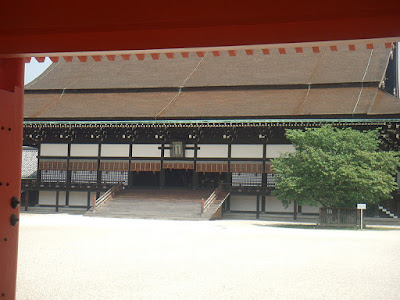 |
| Inside Kyoto's Imperial Palace |
However in 1868, with the Meiji Restoration, the emperor moved to the Imperial Palace in Tokyo; and what other spot to move to in Tokyo, than to the previous home of the shoguns that had ruled Japan there for the previous 260+ years. Much of the current imperial palace grounds have been shaped by its history as Edo Castle.
The Emperor's Palace, and previous Edo Castle are located in the Minato Ward of Tokyo in Chiyoda. The name of Edo Castle comes from the old name of Tokyo, Edo. Edo was changed to Tokyo in 1868 due to the Emperor's move there. Tokyo (東京) means Eastern Capital, distinguishing it from Kyoto (京都) meaning Capital City. Edo prior to the Tokugawa Shogunate was a small town, but after 1603 when the Tokugawas chose the city to be their capital it quickly grew to become the most important and populous city like it is today. The current site of the palace was chosen by Iyeasu Tokugawa to be the place from where he would command Japan. Edo Castle became his stronghold of defense and administration, and at one point was the most impressive in Japan.
 |
| Edo Castle during 1638-1657 [2] |
I have written a little about the beginnings of Edo Castle from my disucssion about Hie Shrine in my
New Year's Post. Dokan Ota under the Uesugi clan built Edo Castle in 1457, however it would come under control of the Hōjō clan (Not the same clan as that of the Kamakura period, but a family renamed after the famous clan). The Hōjō clan was based in Odawara and upon the siege of Odawara Castle abandoned Edo Castle and eventually lost the siege to Hideyoshi Toyotomi who gave the lands and Edo Castle to his ally Iyeasu Tokugawa in 1590. [3] However, after Tokugawa had defeated the forces of Hideyoshi Toyotomi and started to set up his base of government in Edo, the castle there was found to be in disrepair. Starting work on the castle again in 1603, it took over 30 years to finish and wouldn't be finished until Iemitsu's reign, (Iyeasu's grandson). [4] At this point, the main tower was on a 11 meter base and a 51 meter tall tower, making Edo Castle the tallest one in Japan. It was also the biggest castle in the world with an outer perimeter of over 16 kilometers. [5] Its dominance was not to last, as in 1657 (only 19 years after completion) it was struck by a lightning bolt and the ensuing Great Meireki fire burned down the keep and large sections of Edo (Tokyo). The Donjon (main tower) was never rebuilt. Additional fires in 1853 and 1863 burned down the Honmaru Palace and the Nishinomaru Palace (Residence of the shogun and the retired shoguns / heir-apparents respectively). However, during the Edo Castle days, these were rebuilt. The shogunate's loss in the Meiji Revolution in 1867 forced the shogun to abdicate Edo Castle to Emperor Meiji who would from then on occupy the grounds that would become the Imperial Palace after his move there in 1868.
This will be the 1st of 3 posts regarding the Emperor, Imperial Palace and going to the Imperial Palace to hear the Emperor's New Year's Speech. Next time, I will cover the history of the Emperor's Palace and a tour of the accessible parts of the palace grounds today. The 3rd post will be about my experience of going to the inner part of the Imperial Palace and my experiences of the New Year's speech by the Emperor.
References:
1. "New Year Greeting,"
The Imperial Household Agency.
http://www.kunaicho.go.jp/e-about/kyuchu/shukuga01.html.
2. Username: erbse, "Historic Cityviews: Illustrations and Paintings," posting to Skyscrapercity forums, December 1, 2009,
http://www.skyscrapercity.com/showthread.php?t=1010911&page=2 (accessed November 7, 2011).
3. Aria Murasaka, "Edo Castle,"
Ancient Worlds The Orient,
http://www.ancientsites.com/aw/Article/837886.
4. Ibid.
5. Ibid.


