Showing posts with label Tokugawa I.. Show all posts

Tuesday, January 24, 2012

Ukiyo-e: 'Pictures of the Floating World'

June 12th, 2011:


Sharaku's Actor Ōtani Oniji III as the Manservant Edohei.  Arguably his most famous work. [1]


Today was the last day of the Sharaku exhibit at Tokyo National Museum Heiseikan.  The art teacher at school informed me about the exhibition and recommended that I go.  After looking into the exhibit, I agreed that it was a must-see and we made sure to fit it into our schedule and go before it closed.  The importance of the exhibit was two-fold.  Not only is Sharaku one of the most famous ukiyo-e (woodblock print) artists making the exhibit worthwhile, but the completeness of the exhibit for a major artist is what really made the exhibit unmissable.  There are only thought to be 146 works of Sharaku still existing, and this exhibit brought together over 140 of them. [2]  In fact, at the show, the exhibit said only 4 were missing from the complete works of Sharaku.  His works were brought together from private and public collections from around the world and such an exhibit might not happen again.  This time I'm going to talk about the art of ukiyo-e before I get into Sharaku's life and work and the exhibit itself in my next post.

Ukiyo-e as I'm sure all of you know is the famous Japanese woodblock prints made during the Edo Period and beyond.  Some of the most famous of these artists around the world being Hiroshige and Hokusai; their works depicting landscapes and scenes from daily life during that time in Japan.  Not only are these works famous in themselves, but helped to inspire some of the most famous impressionists and their works when they were discovered in Europe.

Hokusai's The Great Wave at Kanagawa (from a Series of Thirty-Six Views of Mount Fuji).  I'm sure this famous ukiyo-e print looks familiar for example. [3]

Woodblock printing was in use in Japan long before the art of ukiyo-e had developed.  Woodblock printing was already in use at least by the 8th century for producing texts, specifically Buddhist scriptures.  They also were used to print designs on paper and silk in the 17th century, but until the 18th century were used mainly to mass produce texts. [4]  Even the first illustrated Japanese books didn't appear until sometime around 1650 when traditional tales began to be produced.  The illustrations in these books increased in quality as the books became more popular and soon the books were being purchased for the artwork in them as much, or in some cases more so than the written text. [5]  By 1660, Hishikawa Moronobu, an illustrator working in Edo convinced his publisher to print single sheet illustrations which then became widely sold and started the ukiyo-e movement. [6]  These prints became the first widely available art in Japan.

The question being is why did it take so long to go from the creation of woodblock printing to its use in ukiyo-e and the mass-popularity of its art.  The main reason is societal and economic conditions were not ready for this kind of populist art development until this period.  Japan itself would not become fully unified as a country until unification was completed by Iyeasu Tokugawa with victory at the Battle of Sekigahara on October 21st, 1600, officially by being given the title of Shōgun by the Emperor in 1603 and completed with victory at the Battle of Tennoji in 1615.  Before this point, Japan was a fractured place with a large number of clans and a history of violence between these clans, as well as violence between the Emperors and strong generals over power in Japan in previous eras.  The Sengoku Period (Warring States Period, 1467-1600) right before unification was a time of Japan's greatest fragmentation and conflict as Japan was in a civil war when many Daimyō, or local clan lords rose to power and fought against each other for more power.  With constant war throughout the country and people stuck inside the land of their clan, there wasn't the stability, freedom or economic conditions that would be required for the creation and selling of populist art.

With the unification of Japan and future reforms by the Tokugawa Shogunate after 1600, conditions were finally present for the making and selling of art within Japan.  With the country unified by Tokugawa, it created stability and peace in Japan for over 250 years.  These conditions allowed for the emergence of arts as finances no longer needed to be funneled into military and defense.  The ruling samurai class started to pay for art and craftsmanship with decorations for their castles, sliding doors, ceilings, wood panels, new fancy clothes and other goods to show off and take advantage of their high status no longer encumbered with funding for defense and wars. [7]  While the samurai class started to again be patrons of the arts, it would be the economic rise of the lowest social class in Edo Era society that would create the conditions for the birth of the ukiyo-e movement.

The Tokugawa Shogunate made a new societal structure that lasted until the end of the Edo Era based on 4 classes.  The samurai class was on top followed by farmers, artisans and at the bottom, the merchant class.  While the merchant class was the lowest class in society, many in the class would acquire new wealth during this period.  These merchants would become wealthy from the expansion of cities and commerce that occurred during this time.  Becoming wealthy, but lacking social mobility being at the bottom of society, the merchant class used their money in acquiring items to show their status. [8]  This collection of items and decorations would be separate from the high culture and art of the upper samurai class and instead be the creation of a new populist culture.  Some of the first cultural expressions from this new merchant class led culture were paintings of courtesans, Kabuki that also started around this time and the illustrated books that I explained before. [9]  The merchant class being newly enriched and their desire for a new, more populist culture and art set up the conditions for the introduction of ukiyo-e.  They were the logical progression from the illustrated story-books that were popular and collected starting in the early Edo Era.

One last invention in the printing process was needed before the popularity of ukiyo-e could be fully realized.  Hishikawa Moronobu's first works in ukiyo-e art in the 1660s would have been different than the prints were during its main and late periods.  These early prints and the illustrations in books at this time were either black and white, printed black and white and then painted by hand or printed with only a few colors.  It wouldn't be until 1765 that the technology would be available to print polychromatic on the same sheet of paper.  These nishiki-e (錦絵), or "brocade picture" were first used for calendars commissioned by a group of wealthy patrons in Edo for a New Year custom of exchanging calendars. [10]  These and the future works of Suzuki Harunobu would make him the most popular artist in Edo until his death 6 years after first using the new technique in ukiyo-e art. [11]

Suzuki Harunobu's Autumn Moon in the Mirror (from the series Eight Views of  the Parlor). A famous series of his using the polychromatic printing. [12]

Suzuki Harunobu's technique became the basic technique used in ukiyo-e art.  It would be the main popular art form in Japan until the 1860s when Japan would politically and socially destabilize leading up to the Meiji Revolution in 1868.  The Meiji Emperor's rise to power and the end of the Tokugawa Shogunate saw another series of wide social reforms specifically focused on modernization.  Ukiyo-e became a casualty of this modernization effort. [13]

Ukiyo-e (浮世絵)  means 'pictures of the floating world,' but this is an evolution of the original word.  The original word of Ukiyo-e used this kanji, 憂世絵.  Notice the first character is different between the two, 憂 compared to 浮 now.  Both kanji are read as uki, but have different meanings.  The original ukiyo-e, 憂世絵 means 'pictures of the sad world' or pictures of the transient world.'  This is the Buddhist idea of the transient nature of life.  This concept obviously didn't match the subject matter of ukiyo-e art at the time, being of courtesans, kabuki actors and scenes from the pleasure districts popular at the time.  So the first kanji of uki 憂 was changed to the homonym 浮, which was a better fit.  浮 means to float, so the word now means 'pictures of the floating world' matching the subject matter of its art better. [14]

Ukiyo-e has become the most famous art of Japan worldwide and the reason for that is two-fold.  The first being ukiyo-e's impact around the world, started by the impressionists finding them and inspiring their work.  This discovery spurred a Japonism in the art world separate from the Orientalism that already existed which has influenced western art ever since.  The more important aspect for ukiyo-e's fame is its subject matter.  Ukiyo-e depicted scenes of the city, pleasure districts, entertainment and landscapes of the time.  In that way, ukiyo-e has become a visual record of Edo Era and traditional Japan.  After the Edo Era, Japan modernized and westernized to some extent during this modernization, so the Edo era would be the last time Japan would be the Japan of old and the traditional.  The ukiyo-e would thus be the main visual reminders of this traditional Japan as photography would not come to Japan until late in the Edo Era.  Ukiyo-e are famous and popular in Japan as well as around the world for this showing of traditional Japan.

One other thing to remember about ukiyo-e art is the artists that are credited with the work are often only 1 of the people that create these works.  Usually each print is the work of 4 people.  Each print needs the work of a designer, engraver, printer and publisher. [15]  The artist typically credited with the work when being discussed is only the designer of the piece.  However, the publisher decided the themes and judged the quality of the design before it was given to the engraver and printer for production. [16]  So while currently only the designer is given credit for the works, there were typically 4 people involved in the process of making the art and not just the artist credited with the work.

This is the basic background for the art of ukiyo-e and the conditions at the time that allowed and shaped the emergence of this work.  Hopefully this provides the context that makes it easier to understand the works of Sharaku and the exhibit, which I'll discuss next time.

References:

1. The Metropolitan Museum of Art, "Toshusai Sharaku: Otani Oniji II (JP2822)," Heilbrunn Timeline of Art History. http://www.metmuseum.org/toah/works-of-art/JP2822.

2. Kumi Matsumaru, "The many faces of Sharaku," Daily Yomiuri Online, May 20, 2011, http://www.yomiuri.co.jp/dy/features/arts/T110519003574.htm (accessed January 21, 2012).

3.The Metropolitan Museum of Art, "Katsushika Hokusai: The Great Wave at Kanagawa (from a Series of Thirty-Six Views of Mount Fuji) (JP1847)," Heilbrunn Timeline of Art History. http://www.metmuseum.org/toah/works-of-art/JP1847.

4. Department of Asian Art, The Metropolitan Museum of Art, "Woodblock Prints in the Ukiyo-e Style," Heilbrunn Timeline of Art History. http://www.metmuseum.org/toah/hd/ukiy/hd_ukiy.htm.

5. "Ukiyo-e History," Tokugawa Gallery.
http://tokugawagallery.com/history.html.

6. Ibid.

7. Ibid.

8. Department of Asian Art, The Metropolitan Museum of Art, "Art of the Pleasure Quarters and the Ukiyo-e Style," Heilbrunn Timeline of Art History. http://www.metmuseum.org/toah/hd/plea/hd_plea.htm.

9. "Ukiyo-e History," Tokugawa Gallery.

10. Department of Asian Art, The Metropolitan Museum of Art, "Woodblock Prints in the Ukiyo-e Style."

11. John Fiorillo, "Suzuki Harunobu (c. 1725-1770)," Viewing Japanese Prints.
http://www.viewingjapaneseprints.net/texts/ukiyoetexts/ukiyoe_pages/harunobu3.html.

12. "Autumn Moon in the Mirror," Mokuhankan Catalogue.
http://mokuhankan.com/catalogue/T007.html.

13. Department of Asian Art, The Metropolitan Museum of Art, "Art of the Pleasure Quarters and the Ukiyo-e Style."

14. Ibid.

15. Department of Asian Art, The Metropolitan Museum of Art, "Woodblock Prints in the Ukiyo-e Style."

16. Ibid.

Tuesday, November 8, 2011

The History and Estate of Emperors

Jan. 2nd, 2011:


Today is one of two days all year that the Imperial Palace in Tokyo is open.  For most of the year, the Imperial Household is tucked and guarded away behind Nijubashi (Japan's most famous pair of bridges) and the old fortifications of Edo Castle.


However, today for New Year's and on the Emperor's birthday (December 23rd), the palace is open to the public.  Every New Year, the Emperor makes a speech to the people of Japan.  This year, 77,110 people came to the palace to hear him speak. [1]  The Emperor gives this speech from a balcony within the palace so people are able to come to the palace on that day and see the Emperor and listen to his speech at certain times throughout the day.  Once I found out about the opportunity to be able to enter the Imperial Palace and see the Emperor, I had been looking forward to the rare opportunity.

The emperor and imperial line are steeped in history, reverence and even strong religious connotations.  The Japanese Imperial Line is the longest continuous monarchy in the world and until 1945 was a deity in Japanese Shinto religion.  This divinity was renounced by Emperor Hirohito (Shōwa) at the end of World War II as required for Japan's reconstruction, but even now Emperor Akihito still has a reverence among the people that for some can border that of a religious nature.  The beginnings of the imperial line started with Emperor Jimmu in 660.  Emperor's names can get a little confusing for people not used to the Japanese naming of emperors.  As you can see, I have been including 2 names for the emperors that I have been writing about.  The reason for this is emperors actually have 2 names.  These are given names while living (although these given names aren't said by Japanese as they are seen as not respectful enough and are only used by people outside of Japan) and then a posthumous name given after death.  In the past, these names could be of a variety of things but since Emperor Meiji, they have corresponded to the era the emperor reigned in.  I will be posting the posthumous name first followed by given name in parenthesis, except for Emperor Hirohito as I feel most people would know this name, but be confused regarding the posthumous name so I have switched the two names for this.

Much of Japan's history following Emperor Jimmu's reign was either in the leadership of the emperor or a variety of dynamic power struggles between the emperor and strong generals at the time.  The religious impact of the title of emperor was developed firstly and mainly through The Kojiki and further added to in the Nihongi.

The Kojiki (古事記) (Records of Ancient Matters) was written in 712 under the original command by Emperor Temmu, but completed in Empress Genmyō's reign.  The Kojiki is a collection of the histories, religion, mythologies, songs and poems as dictated by Emperor Temmu.  The Kojiki is the basis of Shintoism in Japan and ties the link between the emperor and the gods.  In it, Jimmu is the offspring of the grandson of Amaterasu, the Japanese Sun Goddess.  This connection is further strengthened by the inclusion of 3 holy artifacts, the Sanshu no Jingi (三種の神器) (three sacred regalia):  sacred sword, sacred mirror and curved jewels.  These artifacts are thought to still be surviving today, located in 3 important shrines in Japan: the sword in Atsuta Jingu, Aichi Prefecture, the mirror in Ise Jingu, Mie Prefecture and the curved jewels in the Imperial Palace, Tokyo.  Shinto further developed from the Kojiki with the Emperor being one of its Gods from its beginning to 1945.

While the religious and cultural position of the Emperor was never questioned, his political position was often greatly in conflict in the following centuries.  Here's a short overview of the power of the emperor in Japan throughout the centuries.  The emperors had begun in the late Kofun Period (250-710) and continued to rule throughout the Nara and Heian Periods (710-794, 794-1185).  However these periods, saw the imperial court life focused more on etiquette and art and less on governing.  Their actual power had grown weak by the end of this period and much of the governing was placed on local lords.  This problem would come to a head in the next period, the Kamakura Period (1185-1333).

Two family lines that had been barred from succession, the Genji (Minamoto) and Heike (Taira) clans were brought back in the 1150s to help weaken the Fujiwara family that were in charge of the imperial court at the time as a powerful regency over the emperors.  The Heike clan at first held power in the imperial court, but Yoritomo Minamoto, the leader of the Genji clan would defeat his rivals in a series of battles from 1180-1185.  By the end, the Heike were almost completely wiped out and Moritomo held the power over Japan.  The Kamakura period was one marked by the Genji and later the Hōjō clans being the real leaders of Japan and given the title of shogun from the emperor.  Invasions from the Mongols in 1274 and 1281 had weakened the shogunate, especially financially, and an uprising by the exiled Emperor Go-Daigo helped by the betrayal of the Hōjō's own general Takauji Ashikaga had defeated the Hōjō Shogunate.

Afterwards, Takauji and Go-Daigo fought each other over control and Takauji won the battle leaving the Emperor Go-Daigo to flee and set up a court south of Kyoto.  Takauji Ashikaga set up another court in Muromachi, Kyoto and was granted the title of shogun by the emperor that he installed at the court, starting the Muromachi Period (1333-1568).  The southern court would be defeated in 1392 by Yoshimitsu Ashikaga, who was the grandson of Takauji Ashikaga.  However, this period was marked by very weak central power and the country gradually fell into all-out war between local warlords by the Ōnin War in 1467-1477.  This led to a Warring States Period that was only stopped by a succession of 3 strong generals starting with Nobunaga Oda who was able to take Kyoto in 1568 and made his own base of power over Japan in Azuchi in 1573, leading to the Azuchi-Momoyama Period (1568-1600).  He would be the first of 3 'unifiers' of Japan, along with Hideyoshi Toyotomi following his death and finished by Iyeasu Tokugawa who defeated Hideyoshi Toyotomi and taken power over all of Japan, making a new capital in Edo starting the Edo Period (1600-1868).

During this time, the Tokugawa Shoguns would have complete control over Japan.  This power fell from a combination of the shogunate weakening and the threat from outside invasion as foreign countries started to push their power again Japan, starting with Admiral Perry's forced entry into Japan in 1853 and 1854.  The Tokugawa Shogunate was too weak to attempt any defense and led to unrest and eventually revolution as the Meiji Revolution brought a civil war to Japan and ended with the shogunate ending and the emperor coming to power, starting the Meiji Period (1868-1912).  The emperor held the ruling power until the end of World War II, when the emperor no longer was allowed any official political power and a new democratic system was developed during the reconstruction.

In his present position, the emperor has no official political power but still has an important place culturally, much like other monarchs in other developed nations.  While there was some worry about the lack of a male heir and some mulling about allowing a woman to become emperor, changing the current rules to do so; this crisis was averted when Prince Hisahito was born in 2006.  Otherwise, the only recent events involving the imperial family is their increased public role after the March 11th Earthquake and going to shelters in Tohoku to check on the people living in them.

So what happened to make the Imperial Palace in Tokyo the Emperor's current home?  Prior to 1868, there wasn't even a palace in Tokyo.  The emperors then were living in the Imperial Palace in Kyoto.

One of the outer gates to the Imperial Palace in Kyoto.
One of the outer walls to the Imperial Palace in Kyoto.
Inside Kyoto's Imperial Palace

However in 1868, with the Meiji Restoration, the emperor moved to the Imperial Palace in Tokyo; and what other spot to move to in Tokyo, than to the previous home of the shoguns that had ruled Japan there for the previous 260+ years.  Much of the current imperial palace grounds have been shaped by its history as Edo Castle.

The Emperor's Palace, and previous Edo Castle are located in the Minato Ward of Tokyo in Chiyoda.  The name of Edo Castle comes from the old name of Tokyo, Edo.  Edo was changed to Tokyo in 1868 due to the Emperor's move there.  Tokyo (東京) means Eastern Capital, distinguishing it from Kyoto (京都) meaning Capital City.  Edo prior to the Tokugawa Shogunate was a small town, but after 1603 when the Tokugawas chose the city to be their capital it quickly grew to become the most important and populous city like it is today.  The current site of the palace was chosen by Iyeasu Tokugawa to be the place from where he would command Japan.  Edo Castle became his stronghold of defense and administration, and at one point was the most impressive in Japan.

Edo Castle during 1638-1657 [2]

I have written a little about the beginnings of Edo Castle from my disucssion about Hie Shrine in my New Year's Post.  Dokan Ota under the Uesugi clan built Edo Castle in 1457, however it would come under control of the Hōjō clan (Not the same clan as that of the Kamakura period, but a family renamed after the famous clan).  The Hōjō clan was based in Odawara and upon the siege of Odawara Castle abandoned Edo Castle and eventually lost the siege to Hideyoshi Toyotomi who gave the lands and Edo Castle to his ally Iyeasu Tokugawa in 1590. [3]  However, after Tokugawa had defeated the forces of Hideyoshi Toyotomi and started to set up his base of government in Edo, the castle there was found to be in disrepair.  Starting work on the castle again in 1603, it took over 30 years to finish and wouldn't be finished until Iemitsu's reign, (Iyeasu's grandson). [4]  At this point, the main tower was on a 11 meter base and a 51 meter tall tower, making Edo Castle the tallest one in Japan.  It was also the biggest castle in the world with an outer perimeter of over 16 kilometers. [5]  Its dominance was not to last, as in 1657 (only 19 years after completion) it was struck by a lightning bolt and the ensuing Great Meireki fire burned down the keep and large sections of Edo (Tokyo).  The Donjon (main tower) was never rebuilt.  Additional fires in 1853 and 1863 burned down the Honmaru Palace and the Nishinomaru Palace (Residence of the shogun and the retired shoguns / heir-apparents respectively).  However, during the Edo Castle days, these were rebuilt.  The shogunate's loss in the Meiji Revolution in 1867 forced the shogun to abdicate Edo Castle to Emperor Meiji who would from then on occupy the grounds that would become the Imperial Palace after his move there in 1868.

This will be the 1st of 3 posts regarding the Emperor, Imperial Palace and going to the Imperial Palace to hear the Emperor's New Year's Speech.  Next time, I will cover the history of the Emperor's Palace and a tour of the accessible parts of the palace grounds today.  The 3rd post will be about my experience of going to the inner part of the Imperial Palace and my experiences of the New Year's speech by the Emperor.

References:

1. "New Year Greeting," The Imperial Household Agency.
http://www.kunaicho.go.jp/e-about/kyuchu/shukuga01.html.

2. Username: erbse, "Historic Cityviews: Illustrations and Paintings," posting to Skyscrapercity forums, December 1, 2009,
http://www.skyscrapercity.com/showthread.php?t=1010911&page=2 (accessed November 7, 2011).

3. Aria Murasaka, "Edo Castle," Ancient Worlds The Orient,
http://www.ancientsites.com/aw/Article/837886.

4. Ibid.

5. Ibid.

Friday, October 21, 2011

First Afternoon and Evening (最初の午後と最初の夕方, さいしょのごごとさいしょのゆうがた, Saisho no gogo to saisho no yuugata)

The New Year's series of posts before this one: the basics of Japanese New Year's and some of its traditions here, New Year's Eve and Countdown here and New Year's sunrise, traditional meal and visit to Meiji Jingū here.


Our next Hatsumōde stop is at Hie Shrine (日枝神社, ひえじんじゃ).  Hie Shrine is in Nagata in the Chiyoda Ward of Tokyo.  It is actually very close to where I stayed during my time here as a study abroad student, but oddly enough I never visited the shrine during my time there and this would be my first visit.  


Hie Shrine has it's beginnings in the early Kamakura period (1185-1333) on the current site of the Emperor's Palace.  (I will be getting more into the history of Edo Castle and the Emperor's Palace in my next post, so if this is of interest then be on the lookout for it.)  A man named Edo had built a Hie Shrine here to house the guardian deity of his property.  The deity in Hie Shrines is Ōyamakui-no-kami, which is the God of Mt. Hie in Shiga Prefecture; it is more commonly known as Hie-no-kami. [1]  Shiga Prefecture can be found on the 4th map of my Maps of Japan post.  Ōyamakui-no-kami is the master of the great mountain and look over the growth of everything, especially business. [2]  Hie Shrine's next development would come in 1478 when Ota Dokan built Edo Castle in the same spot and built Sanno-Hie Shrine to house the guardian deity for the castle.  When Iyeasu Tokugawa took over Edo Castle to rule over Edo and Japan as Shogun, he also gave patronage to the shrine and made it a protector of the city of Edo.  Now the guardian deity of the Shogun,  it greatly increased the importance of Hie Shrine and its following from the local people. [3]


Hidetada Tokugawa, 2nd Shogun of the Tokugawa Shogunate moved the shrine in 1607 to near the present day National Theater instead of inside the castle grounds, because citizens of Edo could only visit the shrine two days of the year while it was in the castle grounds.  However this didn't last long as the shrine burned down in a fire along with most of the city in 1657.  When it was rebuilt in 1659, the shrine was moved to its current location.  These shrines buildings were designated as national treasures until they were unfortunately also lost to fire, this time to the air raids of World War II.  The present shrine was rebuilt in 1958 with donations from worshipers of the shrine. [4]


While Hie Shrine is not the most famous of shrines for Hatsumōde, my girlfriend suggested we go because of their wide variety of New Year's Ema for sale.  I have talked previously about ema and collecting them, when I talked about my trip to Enoshima and buying the ema here.  Before the ema, I'll show the shrine experience up to that point.  


The torii leading up to Hie Shrine.  The shrine is on top of the hill in the area, so there are a lot of steps to the top.
The main building of Hie Shrine decorated for New Year's.
Looking back at the entrance of the inner gate.
The statues of two monkeys line the main gate to the shrine.  The monkey is the messenger for  the shrine's god.  These messengers are called masaru (monkey is saru in Japanese) and a play off this word of masaru is ma ga saru, meaning to take a charm to ward off evil.  Monkeys are also considered good luck for childbirth, child rearing and marriage happiness due to their perceived affection towards children. [5]


We actually didn't make our wishes or pray at this shrine as the line was very long (over an hour wait) and there were no back ways in like Meiji Jingū.  We were also running out of time in the day and still had things to do.  However, we did participate and watch several of the New Year's festivities at the shrine.


Shrines often serve a special sake for the New Year's celebration.  This sake is amazake, and is a sweet sake served at shrines for the New Year's holiday.  It was really cheap and certainly worth every yen, as it was delicious.   
Speaking of sake, here is the sake offerings given to Hie Shrine.  This is what the sake offerings usually look like, with a full cask given.  This is actually a very common sight at shrines.
We also watched this ceremony at the shrine.  The shrine maiden takes the protection charms that the worshipers have bought from the shrine and then prays to the gods for extra protection from them.
After seeing the typical New Year celebrations from the shrine, we set out to do what we planned on doing at the shrine.  First, we set out to buy the New Year's Ema.  


Hie Shrine has so many ema that they put out a big bulletin board with all of the ema and a number below them so people can look first and then give the number to the counter when they are ready to buy them.
A closer view of the smaller ema.


As you can see, almost all of the ema have rabbits on them.  That's because this is the year of the rabbit (usagi in Japanese, うさぎ).  Japan still puts importance in the Chinese Zodiac and it's animals.  The rotation for the Zodiac is:


2010: Tiger (寅, とら, Tora)
2011: Rabbit (卯, う, U)
2012: Dragon (辰, たつ, Tatsu)
2013: Snake (巳, み, Mi)
2014: Horse (午, うま, Uma)
2015: Sheep (羊, ひつじ, Hitsuji)
2016: Monkey (申, さる, Saru)
2017: Rooster (酉, とり, Tori)
2018: Dog (戌, いぬ, Inu)
2019: Boar (Pig in Chinese) (亥, い, I)
2020: Rat (子, ね, Ne)
2021: Ox (丑, うし, Ushi)


Here are the ema I picked up from Hie Shrine:


The last thing to do at Hie Shrine was to get the New Year's Goshuin.


Our last stop of the day was to our local neighborhood shrine of Yoyogi Hachiman for Hatsumōde.  I talked about my local shrine before during the neighborhood Awa Odori Festival.  Even though the New Year festivities were much smaller at this shrine, being the neighborhood shrine made the event as special as any of the other shrines we visited during the day.


The shrine lit by New Year's lanterns.


While it might seem like this was really late in the day, we arrived there early evening.  Japan's sunrise and sunset are both very early and with no Daylight's Savings Time like in the US, it gets dark here pretty early during the winter.


A closer picture of the lanterns set up at the entrance.
This ring of bound grasses is used at shrines for the new year to clean the body of bad luck or bad things accumulated throughout the previous year.
The main hall decorated for New Year's.  The bells on the rope are rung by the worshipers to let the gods at the shrine know the people are there before making their wish and prayers for the New Year.


After making our wishes and prayers for the New Year, we went to get the New Year's Goshuin from the shrine.


After getting the Goshuin, we returned home ending our festivities for New Year's Day.  There was so much to do, and I was glad to be able to experience all of the amazing things that the New Year's holiday has to offer in Japan.  I look forward to the holiday next year and participating in the same things again, and maybe trying some new traditions for New Year's too.


References:


1. "Brief History of Hie Jinja," Hie Jinja.
http://www.hiejinja.net/jinja/english/history.html.


2. Terue Kawai, "Shrines - Bastions for the Japanese Heart and Soul Down Through the Ages," Marunouchi.com
http://www.marunouchi.com/e/interview/marunouchi2011_11_01.html.


3. "Brief History," Hie Jinja.


4. Terue Kawai, "Shrines - Bastions for the Japanese Heart and Soul," Marunouchi.com.


5. Ibid.

Saturday, October 15, 2011

2011 New Year's Countdown (二千十一年 New Year's Countdown, にせんじゅういちねん New Year's Countdown)

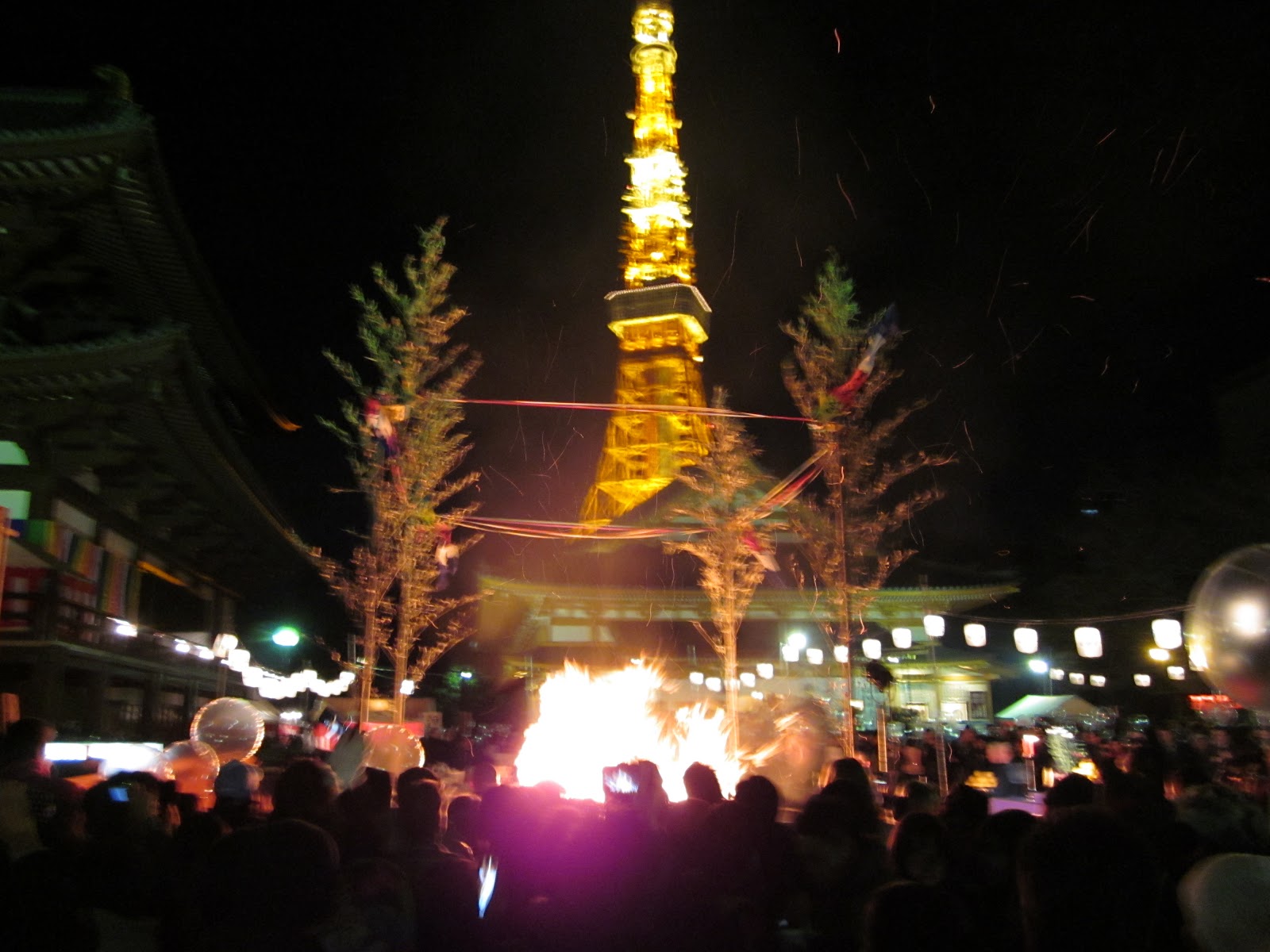
Zōjō-ji after midnight on New Year's 2011.

The New Year's holiday in Japan has a lot to offer and we tried to experience as much of it as we could this year.  It's too much to cover in one post, so I will be breaking it up into two posts.  The first post will cover New Year's Eve.  The post following this will be New Year's Day. In my introduction, I explained some of the background and different traditional happenings during the New Year's holiday in Japan.  I will be adding and expanding on these with the traditional and cultural events I was able to take part in this year.  On New Year's Eve, we decided to go to the popular and famous New Year's Countdown held at Zōjō-ji.


Zōjō-ji is a Buddhist temple located in the Minato Ward of Tokyo.  Today, it's probably most well known for being the temple next to Tokyo Tower, which is the Eiffel Tower look-a-like in the picture above, but Zōjō-ji has had an important history which I will get into a little detail about before continuing with the New Year's festivities.  


Zōjō-ji was founded in 1393 as the orthodox nembutsu seminary for Jodo shu. [1]  Without diving too deep into Japanese Buddhism, which would need its own set of posts by itself, Jodo shu is more commonly known as Pure Land Buddhism, where anyone is able to achieve salvation and be reborn in the Pure Land.  Jodo shu  is a Chinese development of Buddhism based of Mahayana (Greater Vehicle) Buddhism that originated in India.  One of the main tenets of Jodo shu is Senju Nembutsu, or the recitation of the nembutsu prayer "Namu Amida Butsu" that one can achieve salvation. [2]  


The biggest change for Zōjō-ji came in 1598 when the temple was relocated to its present location by Iyeasu Tokugawa.  Iyeasu Tokugawa is known as the unifier of Japan and began the Tokugawa Shogunate, which would rule Japan from 1603-1868.  Zōjō-ji became the personal family temple of the Tokugawas.  Six of the fifteen Tokugawa Shoguns are buried here, including Hidetada Tokugawa, who was Iyeasu's son.  At its height in importance and size during this period; the following period of the Meiji Period marked a decline like other Buddhist temples at the time when Buddhism was dismissed in favor of Shinto. (I have discussed this anti-Buddhism further in the 3rd paragraph of my previous entry on Enoshima, where the same thing happened to Buddhist temples there.)  Most of the temple complex was burned down during the air raids of World War II, but have since been rebuilt and it still remains the main temple of the Jodo shu sect.  Here is what the temple complex looks like today.


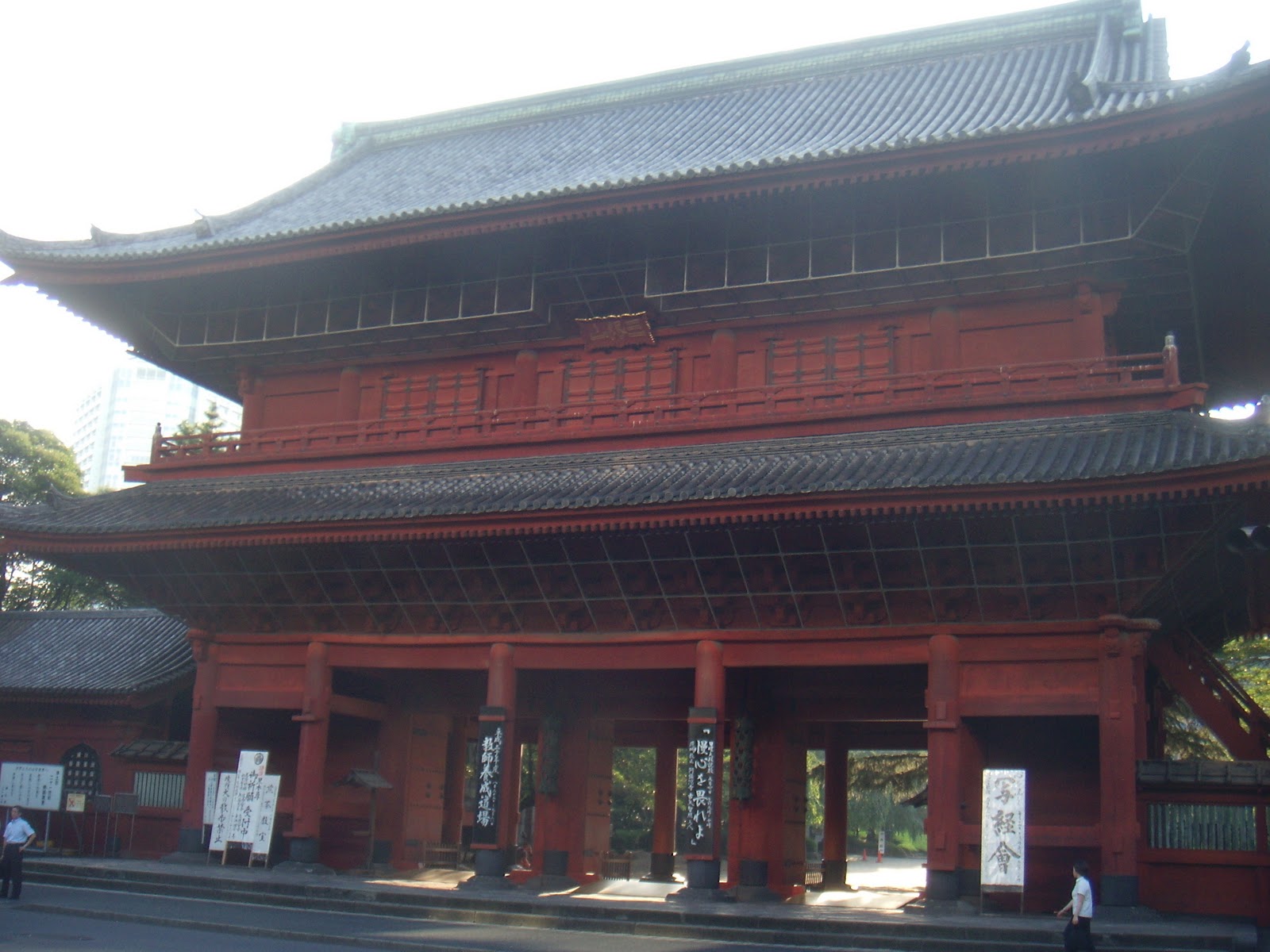
Sangedatsumon, the huge main gate to the temple complex.


Sangedatsumon (三解脱門, さんげだつもん) is the only surviving building from World War II.  The gate was built in 1622 and stands at 21 meters in height, 28.7 meters in width and 17.6 meters in depth.  Sangedatsumon means three (san), liberated from earthly desires (gedatsu) and gate (mon).  Passing through this gate is supposed to relieve one from the three earthly passions of: greed, anger and stupidity which block enlightenment and continues the cycle of birth, death and rebirth in Buddhism. [3]

Right after the gate is this tree:


While not very impressive by itself, the story behind it might surprise you.  In 1877, the famous Civil War General, Ulysses S. Grant had left the White House finishing his second term as president with a damaged reputation due to government corruption during his years as president.  Grant then decided to go on a world tour in hopes that his reception abroad would cause Americans to forget what had happened during his presidency and give him a chance to win the nomination in the next election.  Grant went even to Asia, far from well known and with few relations to the United States at the time.  While in Japan, he received an audience with Emperor Meiji, whose Imperial line returned to power with the Meiji Restoration in 1868, just 11 years prior to his visit.  While here, Grant had planted a cedar in Zōjō-ji which is still there to this day. [4]

Daibonshō
The Daibonshō (大梵鐘, だいぼんしょう), meaning large temple bell, was crafted in 1673 with a diameter of 1.76 meters, a height of 3.33 meters and a weight of 15 tons.  It is still known as one of the big 3 bells of the Edo Period. [5]  The temple bell plays a very important role in the New Year festivity of Joya no kane (除夜の鐘, じょやのかね), which I'll explain when the time comes.

Continuing through the temple and up the main steps is the main building.

Daiden (Main Hall) with Tokyo Tower hiding behind it.

The Daiden (大殿, だいでん) is the main hall of the temple, with Tokyo Tower behind it making it one of the famous temple sights in Tokyo.  It's the building in the 1st picture of this entry.  Inside are the main images of: Amida Buddha, made in the Muromachi Period (1336-1573), the image of Shan-tao on the right, who perfected China's Pure Land Buddhism and the image of Honen Shonin on the left, who founded Japan's Jodo Shu. [6]

The other building that was part of my New Year's experience at Zōjō-ji was Ankokuden.

Ankokuden with an illuminated Tokyo Tower in the background.

Ankokuden holds the Black Image of Amida Buddha.  This Buddha was worshipped by Iyeasu Tokugawa and is said to have saved him many times and bring him victory in battle.  It is now known as a miracle working Buddha that gives victory and defends against evil. [7]

Sorry about the size, but like most shrines and temples, it's impossible to get too close.  In the middle is the Black Image of Amida Buddha.
The complete family tree of the Tokugawas beginning at Iyeasu.  The 15 shoguns from this family line are marked in green.

The temple has more buildings and interesting parts then what I've showed, but I'll try and get back to topic at hand with New Year's.  If people are interested in learning more about Zōjō-ji post a comment below and I'll get back to Zōjō-ji and write another post about it in the future.

Before heading to Zōjō-ji for the countdown we had the traditional New Year's meal at home.


The traditional meal to eat at New Years is toshikoshi soba (年越しそば, としこしそば).  The long noodles represent longevity, which is granted to the person eating them.  We had tempura (天ぷら, てんぷら) with ours, which is Japanese deep frying, in this case shrimp.

One of the major draws to the countdown at Zōjō-ji is the temple hands out wish cards and balloons that get released at midnight, granting the wish to the person.  However being one of the people who get to participate is a 2 step long process on New Years Eve, so we had to head to the temple early.  The first step is to get the wish card, which is done at 8:30 P.M.  The temple only has about 3,000 balloons to hand out so they only hand out wish cards to the first 3,000 people or so.  We got there a bit early, but still barely made the cut.  After a minute or two in line they stopped allowing people to enter.  Then at 10:30 you bring the wish card with you to get your balloon at the temple.  The people that are living close to the area might go home during that time, but Zōjō-ji is pretty far from our place so it wasn't an option.

Sangedatsumon decorated for the New Year's countdown and holiday.

The front of the admission ticket to get the wish card.
The back of the admission ticket in English.

The front of the wish card.  Japan also follows the Zodiac Animals.  2011 is the year of the rabbit.
The back of the wish card.

The main hall, Daiden decorated for New Year's with a lit up Tokyo Tower in the background.

The temple had countdown clocks in a variety of spots.

In front of Sangedatsumon.
In front of the main hall, Daiden.

Besides the countdown, the temple has many important New Year's rituals to conduct at this time.  Visiting the temple during the New Year's holiday is a special time as many rituals are publicly performed and temples are often much more open at this time than throughout the year.  It's a good chance to see some of the more famous religious items (also the oldest and highest craftsmanship) that the temple might have more concealed throughout the year  At Zōjō-ji, the main hall was open for people and the main image was displayed more in the open than it usually is.

The temple's main image along with New Year's decorations that stand out amongst the usual items on the altar.

The rest of Zōjō-ji was also decorated for the New Year's holiday.

Ankokuden during New Year's.
Daibonshō with New Year's decorations.

We were able to watch one of the rituals performed at the temple before midnight.  The ritual involves the burning of the old charms, protections and other religious items from the year.  At the end of the year, temples and shrines collect the religious items people had bought from that year and burn them, while people get new ones for the coming year.

The monks presiding over the ceremony before burning the objects.
The burning of the religious objects.

At this point, it was time to get our balloons.  We took our wish cards over to redeem our balloons and prepare for New Year's.

They smartly gave out the balloons enclosed in a room, so none would escape by accident as people attached their wish cards to the balloons.

After getting our balloons the only thing left to do was to find a good spot near the bell and wait for New Year's to come.

Along with everything else in Tokyo, tons of other people.

The temple monks preparing for the Joya no kane ceremony.

Our New Year's balloons with wish cards attached ready to be released (don't worry, they were completely biodegradable) and our wishes granted.

The final countdown for the New Year is basically the same as it is back in the United States (well except for the Japanese).


After the countdown, the temple held the Joya no kane ceremony.  The Joya no kane ceremony is the 108 bell rings on New Year's Eve night.  At Buddhist temples across Japan on New Year's, the temple's bell is rung 108 times at New Year's.  The number 108 is for the 108 possible sins man can do as believed in Buddhism. The bell is rung 108 times to absolve all of the sins a person committed in the previous year.  The people in the town, or those that come to the ceremony sign up to be able to be one of the groups that is allowed to ring the bell during this time.  This is the main function of Buddhist temples in Japan for New Year's, while shrines are usually the focus of hatsumōde (初詣, はつもうで) or first visit to shrine or temple of the year.  


Families going to ring the bell during Joya no kane.


Even after Joya no kane, the New Year's Eve celebrations are not over yet.  Everyone who was there for the countdown now rushes to the main hall for Zōjō-ji's Hatsumōde, where the crowds are so large police need to direct the crowds and many times I felt squished or ready to be pushed off the steps that led up to the main hall.


At this point people buy fortunes, charms and protections for the New Year from the temple.  While we didn't buy any of that, my girlfriend and I decided to start a new collection throughout the year.  Shrines and temples have goshuin (御朱印, ごしゅいん) for sale.  Goshuin are special red stamps and signatures that the shrine or temple sign for visitors.  The shrine and temples also sell a notebook that can be used to collect these goshuin.  These goshuin confer protection on the person from the shrine or temple.  I'm not as interested in that, as I am interested in their value artistically, with the Japanese calligraphy.  We saw it on a trip to Todai-ji for the first time last year and I finally decided I wanted to start collecting them from the temples and shrines that I go to starting in the new year.  I bought the notebook and my first goshuin in the New Year at Zōjō-ji.

The cover of the Goshuin notebook (each shrine or temple has different covers, collectible in its own right).

Zōjō-ji's New Year's Goshuin

After getting the Goshuin, we head back home to get a little sleep before preparing for another busy day celebrating New Year festivities tomorrow.

明けましておめでとうございます
あけましておめでとうございます
Akemashite Omedetou Gozaimasu
Happy New Year's


References:

1. "Main Temple of Jodo shu (Pure Land Sect) of Buddhism," Zojoji Temple.
 http://www.zojoji.or.jp/en/index.html#top.

2. Ibid.

3. Ibid.

4. "General Article: Grant's World Tour," PBS.
 http://www.pbs.org/wgbh/americanexperience/features/general-article/grant-tour/.

5. "Main Temple of Jodo shu (Pure Land Sect) of Buddhism," Zojoji Temple.

6. Ibid.

7. Ibid.