The Emperor moved to the Imperial Palace in the 10th month on the 23rd day of 1868 (Remember Japan would still be operating under the lunar calendar at this time). During that time Edo Castle was renamed to Tokyo Castle. However, in 1869 it was again renamed to Imperial Castle (皇城, Kōjō). While 1868 was when the site of Edo Castle officially turned from the shogun's castle to the imperial palace, 1873 might have been the final symbolic change of the change in residence. May 5th, 1873 was the final of many fires to plague the old Edo Castle. This time, the fire had destroyed the shogun's official residence, and at this point most of the buildings from the days of Edo Castle had disappeared. Even today, the only reminders of Edo Castle are in the walls, the base of the main keep and a few of the towers that have survived. The final symbolic transfer of the Edo Castle to the Imperial Palace was the construction of the Imperial Castle on the old site of the shogun's residence, completed in 1888. The buildings at this time were an eclectic mix of popular European fashions at the time and tradition Japanese elements. However, in World War II, much of the palace was again lost to fire in the air raids that happened at the end of the war.
After the war, the lands of the imperial palace were handed over to the state as required by the new constitution enacted in 1947. [1] Some of these lands are granted to the use of the emperor and imperial family through the Imperial Household Agency. With most of the palace damaged or destroyed in World War II, a new main building was built. The main hall was completed in October of 1968 and opened in April of 1970 for use. The new palace is made of the Seiden, or main hall and connects to 6 wings, the most important being Homei-Den, Rensui, Chowa-Den, Chigusa-no-Ma and Chidori-no-Ma. [2] The current palace is made using modern architecture with traditional Japanese architecture and elements included. It's a 2 story steel framed building with an underground floor as well. [3] The main hall is now basically used to receive state guests, hold state ceremonies and official functions including meetings between the Emperor and the Prime Minister and other ambassadors. [4] Today, the palace makes up 7.41 square kilometers. [5] Actually in the bubble years of Japan's economy in the late 1980s, it was thought that the Imperial Palace Grounds were worth more than the entire state of California (423,970 square kilometers). [6] While the palace itself is off-limits most of the year, the rest of the grounds are open to the public and there are some great places to go, especially during the different blossom seasons.
 |
| The map of the Imperial Palace. [7] |
The western parts of the palace are the parts that are off-limits for most of the year. This includes the palace buildings and the Fukiage Gardens. The rest of the palace grounds are open to the public. Here's a tour.
The public space to the palace is comprised of 3 main parks. These are the Kokyogaien, the Kokyo Higashi Gyoen and the Kitanomaru. They are the outer gardens, the eastern gardens and the northern park respectively. While the palace grounds now are quite smaller than at the height of Edo Castle, the inner moat still surrounds the palace grounds. For this tour I won't be talking about the Kitanomaru Park, as it is relatively removed from the rest of the palace.
 |
| A map showing the 3 main parks and their location better. [8] |
Here's a map I have made for the Imperial Palace Tour:
View Tokyo Imperial Palace Tour Map in a larger map
Heading to the Kokyogaien (皇居外苑) part of the palace is to the south and is some of the most open green spaces here. This area is famous for the many black pines planted in the area, as well as the Nijubashi bridges and the Main Gate to the palace are here as well.
1. Sakuradamon (桜田門)
This spot is the largest remaining gate of the Imperial Palace and a popular entry point to the palace grounds. Sakuradamon means Cherry Field Gate. Like the other gates, there are two gates to the gate, with a bridge over the moat leading to the first gate and then a 90 degree angle turn to access the second gate, making the siege of the second gate even more deadly than that of the first.
 |
| Sakuradamon from afar on the approach. |
 |
| Bridge and first gate. |
 |
| A detail of the roof of the tower to the second gate (to the right of the previous picture). The ornament on the top is called Shachihoko (鯱), which is a mythological half tiger / half carp animal. They are thought to bring rain and also to spray water at any fire they see. Therefore, on castles and towers there are often two of them, one on each side of the roofline to protect the building from fire. |

 |
| The inner gate to Sakuradamon set at a 90 degree angle to the outer one for defense. You can see the Shachihoko's pair in the upper left. |
 |
| Looking back at the inner gate from inside Kokyogaien. |
2. Statue of Kusunoki Masashige (楠木 正成)
To the southeast of Kokyogaien and the Imperial Palace is a large statue of Kusunoki Masashige.
 |
| The statue of Kusunoki Masashige. |


Like the other statues in the Imperial Palace, Masashige Kusunoki is a legendary figure who aided the emperors at some point in their history. Masashige Kusunoki (1294-1336) helped Emperor Go-Daigo. If you remember from the last post, I wrote about Emperor Go-Daigo who fought against the Hōjō Shogunate and with the help of Takauji Ashikaga defeated them, but later lost the ensuing power struggle against Takauji Ashikaga. During this time, Masashige Kusunoki became the epitome of loyalty to the Emperor.
In 1331, Masashige Kusunoki had answered the Emperor's call to fight the Hōjō. [9] As would become common practice for the rest of his life, he supported the Emperor regardless of odds, and those odds were almost always decidely against him as little other support came to the emperor during this time. His first assignment was to fortify Akasaka, which was a hill near the current Emperor's palace, however during his time there wasn't much of anything there. Severely outnumbered, he was still able to kill large amounts of the enemy until they captured the water supply to his fort. Even after this situation in which defeat was only a mater of time, Masashige still escaped by faking his death, burning the castle down and escaping to fight another day. [10]
After a few smaller battles in the next year, Masashige would again be assigned to a new castle to defend. Masashige would defend Chihaya, while Prince Morinaga would defend Yoshino and another general would again defend the hills of Akasaka. By March however, Yoshino and Akasaka would fall leaving Masashige Kusunoki by himself again. The fort of Chihaya was not only a much stronger fortress, but Masashige had time to prepare its defense. The presence of an internal well would also prevent the problems that happened last time. [11] This time the armies of Hōjō had lost even more men trying to attack the castle, exasperbated by the Shogun's demands to attack the castle for a speedy conclusion instead of a general siege. This order might have been pressured by the increasing amount of troops being recruited by Prince Morinaga and the recently escaped Emperor Go-Daigo. Their efforts no doubt being helped by the successful defense of Chihaya. [12] This would set up the outcome of the rest of the war between the Emperor and the Hōjō Shogunate. A large reinforcing army was sent under the leadership of Takauji Ashikaga. Commanding the most powerful army and with all other troops tied up in the attack on Chihaya, Takauji decided to revolt and instead captured Kyoto for the Emperor Go-Daigo. His capturing of Kyoto and Nitta Yoshida's turning against the Hōjō Shogunate as well and invading Kamakura ended the Shogunate once and for all. [13]
The conflict was not over however as quickly Takauji and the Emperor Go-Daigo would fight in the ensuing power struggle. Masashige Kusunoki would be called upon again to help the side of the Emperor. By this time, Yoshida Nitta would be the lead general and wanted to attack Takauji directly, while Masashige wanted to vacate Kyoto and go to Mt. Hiei while harassing Takauji's troops until a battle would be in their favor. [14] Unfortunately, the Emperor sided with Yoshida Nitta and Masashige Kusunoki out of loyalty went to battle, even though he was sure it would be his death. The deployment of the loyalist forces left Masashige in an even worse situation, as he was set up along the western embankment where support could be easily cut off. This would be exactly what happened in the battle. When the army of Takauji attacked, the other troops in the loyalist army panicked leaving Masashige alone in battle for one last time. His 700 men forced to face the whole of Takauji's army left them in an unwinnable position, and after 6 hours of fighting with the battle lost, Masashige Kusunoki and his followers would commit suicide. [15]
3. Nijubashi (二重橋)
Nijubashi is Japan's most famous pair of bridges, first built in 1888. Nijubashi means Double Bridge, because when looked at from the front, the bridges look like they are one 2 storied bridge. The first bridge is of stone and the 2nd of steel. The 2nd bridge was originally a wooden bridge, but was rebuilt with steel in 1964.

4. Main Gate (正門)
Seimon is the main gate to the Imperial Palace and is the gate at the end of the first of Nijubashi's bridges. This gate is normally closed, except for special palace functions and is also the entrance to the public for the special events on December 23rd and January 2nd, the Emperor's birthday and Emperor's New Year Speech to the Public. This is the only time the palace is open to the public, and people enter through only this way.
 |
| The Main Gate opened for the Emperor's New Year speech to the public. |
 |
| A closer view. |
5. Fushimi Yagura (伏見櫓)
Fushimi Yagura is the keep near Nijubashi that was a part of Edo Castle, after being taken from Fushimi Castle in Kyoto. This keep is no longer in use and is not a part of the main palace itself. It is a pretty tower and makes a nice backdrop for pictures of Nijubashi as you can see above.

6. Black Pine Forest
Most of the rest of the area of Kokyogaien is a forest of planted black pine trees. These trees use to naturally grow in this area. In the past the area that makes up Kokyogaien were the beaches of an inlet to Tokyo Bay, in which these black pines naturally grew. It would be hard to believe that this area was originally an inlet of the bay, however this was before Edo Castle. Dokan Ota while building Edo Castle, also redirected many of the rivers in the area. This not only made the moats for the castle, but also changed the landscape and made this area no longer an inlet. These trees were replanted here in 1888 and today there are about 2,000 of them. [16]

7. Kikyōmon (桔梗門)
This gate is one of the few remaining from the Ninomaru, which was the palace for heir-apparents to the Tokugawa Shoguns. This gate is also off-limits to the public, however on December 23rd and January 2nd this is the gate that is used by the public to leave the palace.
 |
| From the outside of Kikyōmon in the Kokyogaien. |
 |
| On the inside during the Emperor's New Year's Speech event. |
 |
| A closer look. |
8. Fujimi Yagura (富士見櫓)
Meaning Mt. Fuji Viewing Keep, this keep was the most important keep for most of the life of Edo Castle. It is also known as All Front Sided Castle, as it looks the same from every side. When it was a part of Edo Castle, it was thought that Mt. Fuji could have been seen from the keep at one point, hence its name. This became the main castle after the main castle was destroyed in the fire of 1657 and served that role for the rest of Edo Castle's existence. The largest and most impressive of the remaining keeps, it can be seen from inside the East Garden or when exiting the palace when it is open on December 23rd and January 2nd.


9. Sakurada Yagura (桜田櫓)
Also known as Tatsumi Yagura (巽櫓), it is the only keep remaining in the eastern area of the Imperial Palace. It is easy to spot as it borders the moat all the way to the east near Kikyōmon.
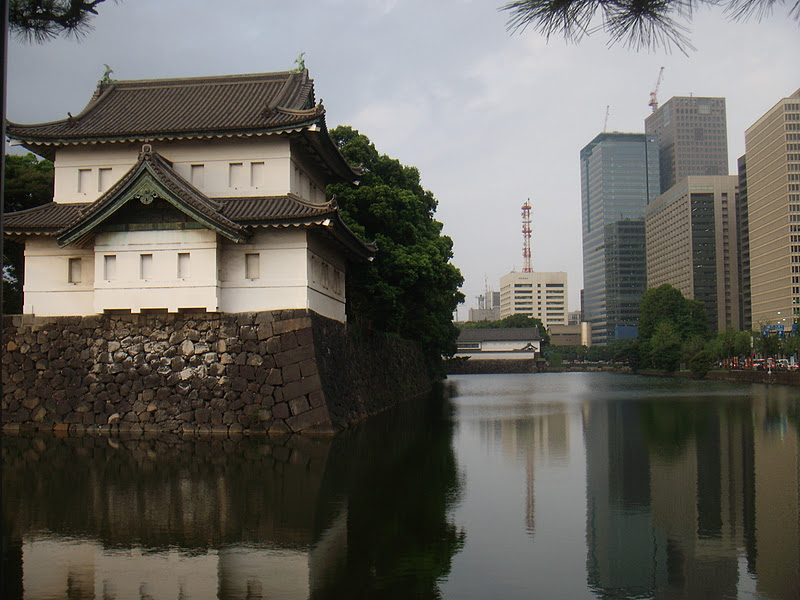 |
| Sakurada Yagura next to the moat. |
 |
| Looking at it from the side, across from the moat. |
10. Ōtemon (大手門)
Meaning Great Hand Gate, this was the main gate to Edo Castle. Ōtemon was originally built in the 1620s by Hidetada Tokegawa, the 2nd Shogun. During the Edo Era, Ōtemon was damaged or destroyed several times. It was destroyed in 1657 by fire and damaged in 1703 and 1855 by earthquakes, but was rebuilt / repaired each time. In the Meiji Era, the 1923 Great Kanto Earthquake saw further damage to the gate where the keep was lost and the walls on both sides needed to be rebuilt. Finally, like most of the rest of the Imperial Palace, this area was burnt down at the end of World War II. Ōtemon was rebuilt in 1965-1967. Today, this is the main gate the public uses to enter the Eastern Garden of the Imperial Palace.
 |
| The front entrance across the moat. |
 |
| Looking back out from inside the 1st gate. |
 |
| The 2nd Gate. |
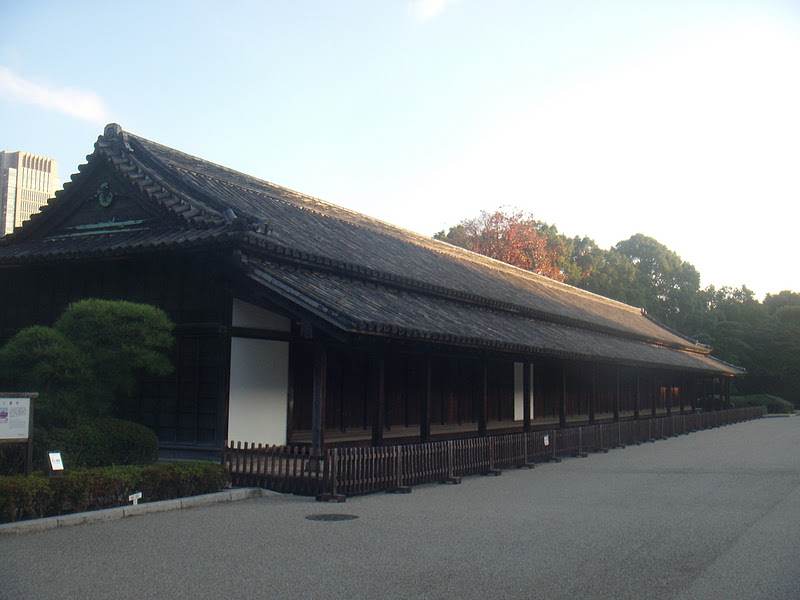
11. Guardhouses (Dōshin-bansho, Hyakunin-bansho and Ō-bansho)
These are three of the few remaining structures inside the walls of the palace from the Edo Castle days. These guardhouses would have samurai guardsmen, that would protect and watch over the main walk-way to Edo Castle. These building are right on the path leading from Ōtemon, so people would have to pass by these building on their way.
The second visible guardhouse is the Hyakunin-bansho (百人番所). Its name meaning 100 Person Guardhouse. The name comes from the fact this guardhouse had 100 samurai posted here to inspect all people entering Edo Castle. This was the largest guardhouse of Edo Castle.

Ō-bansho (大番所), meaning large guardhouse is the last guardhouse before Edo Castle. It is past the large stone walls opposite the Hyakunin-bansho. Being the last checkpoint before the castle and being behind the large stone wall defenses of the inner castle area, this was one of the most important guardhouses in Edo Castle. I unfortunately don't have a picture of this one, but have a picture of the stone walls that lie in front of it.

12. Edo Castle Base (Tenshukaku Donjon, 天守閣)
This stone foundation base is all that remains of the original Edo Castle, the tallest castle in Japan for the 19 years it existed before being burnt down. While the 11 meter base is tall and impressive in itself, try to imagine what it would be like with the 51 meter, 5 story castle on top of it. It would still tower over this area of Tokyo even today if it existed.

13. Tōkagakudō (桃華楽堂)
Tōkagakudō means Peach Blossom Music Hall. This hall is very close to the Edo Castle Base and really can't be missed from there. It is the building with the interesting mosaics and architecture that looks very different than any other building in the palace area. This building was built in 1966 as a commemoration of Empress Kōjun's 60th birthday, March 6th, 1963. Empress Kōjun was the wife of Emperor Hirohito. This building looks really out of place compared to the historic buildings throughout the Imperial Palace, but the mosaics and 8-sidedness of it makes for an interesting building.

14. Suwa-no-Chaya (諏訪の茶屋)
This is the teahouse that is currently located in the East Garden. However, throughout its history it has moved around a bit. During the Edo Castle days, it was in the Fukiage Gardens, which is now part of the main palace grounds. After Emperor Meiji made old Edo Castle the Imperial Palace, this teahouse was moved to the Akasaka Detached Palace. The Akasaka Detached Palace is a nearby palace that main function is to house foreign dignitaries. It was rebuilt back in its original spot at Fukiage Garden in 1912, only to be moved again to its current location in 1968 when the Eastern Garden was being made as a public park.


15. Hirakawamon (平川門)
The original main gate to the east end of Edo Castle. It also was a gate for maidservants to the castle and one of its gates was for the dead and prisoners of Edo Castle. It is the next gate if you are going counter-clockwise around the castle from Ōtemon.

16. Statue of Wake no Kiyomaro
To the northeast of the palace, outside of the palace grounds and beyond the moat is a statue of Wake no Kiyomaro.

Wake no Kiyomaro was also another person important to the history of the Imperial Line. Wake became important during the Doukyou Affair. Doukyou had received favor from the retired Empress Kouken after curing her illnesses in 761 and possibly became her lover. [17] The Empress gradually reasserted power over the Emperor at the time, and by 762 had taken over the important duties again. She eventually returned to the throne in 765 as Empress Shoutoku. [18] With her increased power, Doukyou also gained power and seemed poised to become the next Emperor after a divine proclamation from the god of Hachiman at Usa Shrine said that peace would come to Japan if Doukyou would become the next emperor. However, the Empress received a message from Hachiman to check the authenticity of the message and sent Wake no Kiyomaro to check. [19]
Wake no Kiyomaro reported back with a much different oracle. Emperors could only come from the descendants of Amaterasu, the Japanese Sun Goddess that Emperor Jimmu suppousedly descended from. This meant that Doukyou would not be allowed to be the next Emperor, but instead it would continue through the same family line. Doukyou then ordered Wake no Kiyomaro to be banised and had his tendons cut, only being spared by the powerful rival family. [20] The Empress's unexpected death due to smallpox in 770 led to the family line continued as Emperor, Doukyou removed and exiled and Wake no Kiyomaro brought back and installed into a high position. Upon investigation of the Usa Shrine, it was discovered that the head priest had fabricated the previous oracles in hopes to gain favor with Doukyou as the future emperor. [21]
Wake no Kiyomaro saved the Imperial Line at a time it might have changed families. He stuck to his convictions even when facing oppression for it. For his efforts and help to the Imperial Family his statue now stands among the Imperial Palace Grounds.
Having already visited the rest of the Palace Grounds, I was looking forward to gaining access to the most restricted, secretive and important areas of the palace and to see what was there and see the imperial family.
References:
1. "The Imperial Palace," The Imperial Household Agency.
http://www.kunaicho.go.jp/e-about/shisetsu/kokyo.html.
2. Ibid.
3. Ibid.
4. "Tokyo Imperial Palace History, Facts Picture & Location," Famous Wonders.
http://famouswonders.com/tokyo-imperial-palace/.
5. Ibid.
6. Eric Weiner, "What the U.S. Can Learn from Japan's 'Lost Decade'" NPR.
http://www.npr.org/templates/story/story.php?storyId=88156284.
7. "The Imperial Palace," The Imperial Household Agency.
http://www.kunaicho.go.jp/e-about/shisetsu/kokyo-map.html.
8. "Kokyo Gyoen National Garden," Ministry of Environment.
http://www.env.go.jp/garden/kokyogaien/english/.
9. F.W. Seal, "Kusunoki Masashige 1294-1336," Samurai-Archives.com,
http://www.samurai-archives.com/masashige.html.
10. Ibid.
11. Ibid.
12. Ibid.
13. Ibid.
14. Ibid.
15. Ibid.
16. "Kokyo Gyoen National Garden," Ministry of Environment.
17. "The Doukyou Affair," Journal of an Amateur Japanologist.
http://journalofanamateurjapanologist.wordpress.com/2011/04/20/the-doukyou-affair/.
18. Ibid.
19. Ibid.
20. Ibid.
21. Ibid.
 |
| Dōshin-bansho (同心番所). The first guardhouse along the path from Ōtemon. |
The second visible guardhouse is the Hyakunin-bansho (百人番所). Its name meaning 100 Person Guardhouse. The name comes from the fact this guardhouse had 100 samurai posted here to inspect all people entering Edo Castle. This was the largest guardhouse of Edo Castle.
Ō-bansho (大番所), meaning large guardhouse is the last guardhouse before Edo Castle. It is past the large stone walls opposite the Hyakunin-bansho. Being the last checkpoint before the castle and being behind the large stone wall defenses of the inner castle area, this was one of the most important guardhouses in Edo Castle. I unfortunately don't have a picture of this one, but have a picture of the stone walls that lie in front of it.

12. Edo Castle Base (Tenshukaku Donjon, 天守閣)
This stone foundation base is all that remains of the original Edo Castle, the tallest castle in Japan for the 19 years it existed before being burnt down. While the 11 meter base is tall and impressive in itself, try to imagine what it would be like with the 51 meter, 5 story castle on top of it. It would still tower over this area of Tokyo even today if it existed.

13. Tōkagakudō (桃華楽堂)
Tōkagakudō means Peach Blossom Music Hall. This hall is very close to the Edo Castle Base and really can't be missed from there. It is the building with the interesting mosaics and architecture that looks very different than any other building in the palace area. This building was built in 1966 as a commemoration of Empress Kōjun's 60th birthday, March 6th, 1963. Empress Kōjun was the wife of Emperor Hirohito. This building looks really out of place compared to the historic buildings throughout the Imperial Palace, but the mosaics and 8-sidedness of it makes for an interesting building.

14. Suwa-no-Chaya (諏訪の茶屋)
This is the teahouse that is currently located in the East Garden. However, throughout its history it has moved around a bit. During the Edo Castle days, it was in the Fukiage Gardens, which is now part of the main palace grounds. After Emperor Meiji made old Edo Castle the Imperial Palace, this teahouse was moved to the Akasaka Detached Palace. The Akasaka Detached Palace is a nearby palace that main function is to house foreign dignitaries. It was rebuilt back in its original spot at Fukiage Garden in 1912, only to be moved again to its current location in 1968 when the Eastern Garden was being made as a public park.


15. Hirakawamon (平川門)
The original main gate to the east end of Edo Castle. It also was a gate for maidservants to the castle and one of its gates was for the dead and prisoners of Edo Castle. It is the next gate if you are going counter-clockwise around the castle from Ōtemon.
 |
| Hirakawamon as seen from the base of Edo Castle inside the Imperial Palace. |
 |
| Hirakawamon also has the only remaining wooden bridge on the Imperial Palace Grounds. |

16. Statue of Wake no Kiyomaro
To the northeast of the palace, outside of the palace grounds and beyond the moat is a statue of Wake no Kiyomaro.

Wake no Kiyomaro was also another person important to the history of the Imperial Line. Wake became important during the Doukyou Affair. Doukyou had received favor from the retired Empress Kouken after curing her illnesses in 761 and possibly became her lover. [17] The Empress gradually reasserted power over the Emperor at the time, and by 762 had taken over the important duties again. She eventually returned to the throne in 765 as Empress Shoutoku. [18] With her increased power, Doukyou also gained power and seemed poised to become the next Emperor after a divine proclamation from the god of Hachiman at Usa Shrine said that peace would come to Japan if Doukyou would become the next emperor. However, the Empress received a message from Hachiman to check the authenticity of the message and sent Wake no Kiyomaro to check. [19]
Wake no Kiyomaro reported back with a much different oracle. Emperors could only come from the descendants of Amaterasu, the Japanese Sun Goddess that Emperor Jimmu suppousedly descended from. This meant that Doukyou would not be allowed to be the next Emperor, but instead it would continue through the same family line. Doukyou then ordered Wake no Kiyomaro to be banised and had his tendons cut, only being spared by the powerful rival family. [20] The Empress's unexpected death due to smallpox in 770 led to the family line continued as Emperor, Doukyou removed and exiled and Wake no Kiyomaro brought back and installed into a high position. Upon investigation of the Usa Shrine, it was discovered that the head priest had fabricated the previous oracles in hopes to gain favor with Doukyou as the future emperor. [21]
Wake no Kiyomaro saved the Imperial Line at a time it might have changed families. He stuck to his convictions even when facing oppression for it. For his efforts and help to the Imperial Family his statue now stands among the Imperial Palace Grounds.
Having already visited the rest of the Palace Grounds, I was looking forward to gaining access to the most restricted, secretive and important areas of the palace and to see what was there and see the imperial family.
References:
1. "The Imperial Palace," The Imperial Household Agency.
http://www.kunaicho.go.jp/e-about/shisetsu/kokyo.html.
2. Ibid.
3. Ibid.
4. "Tokyo Imperial Palace History, Facts Picture & Location," Famous Wonders.
http://famouswonders.com/tokyo-imperial-palace/.
5. Ibid.
6. Eric Weiner, "What the U.S. Can Learn from Japan's 'Lost Decade'" NPR.
http://www.npr.org/templates/story/story.php?storyId=88156284.
7. "The Imperial Palace," The Imperial Household Agency.
http://www.kunaicho.go.jp/e-about/shisetsu/kokyo-map.html.
8. "Kokyo Gyoen National Garden," Ministry of Environment.
http://www.env.go.jp/garden/kokyogaien/english/.
9. F.W. Seal, "Kusunoki Masashige 1294-1336," Samurai-Archives.com,
http://www.samurai-archives.com/masashige.html.
10. Ibid.
11. Ibid.
12. Ibid.
13. Ibid.
14. Ibid.
15. Ibid.
16. "Kokyo Gyoen National Garden," Ministry of Environment.
17. "The Doukyou Affair," Journal of an Amateur Japanologist.
http://journalofanamateurjapanologist.wordpress.com/2011/04/20/the-doukyou-affair/.
18. Ibid.
19. Ibid.
20. Ibid.
21. Ibid.


