Showing posts with label New Year's. Show all posts

Saturday, November 19, 2011

An Appointment with the Emperor

Jan. 2nd, 2011:


This is the 3rd of a 3 part series about emperors and the imperial palace.  For the history of the emperors and Edo Castle, which was the predecessor of the Imperial Palace, you can read about it here.  For the history of the Imperial Palace and a tour of the palace grounds open to the public, you can find it here.

Today we headed to the Imperial Palace in the early afternoon for today's events.  During the day, the New Year's speech is given multiple times so there wasn't any need to get there early.  First, we had to go through security near the front of Nijubashi.  The security for this event was easily the most I've seen while in Japan.

After getting through the security we were able to walk up Nijubashi and through the Main Gate normally closed to the public.

The view of Fushimi Yagura and the Steel Bridge of Nijubashi while standing on the Stone Bridge of Nijubashi.

One of the decorative lamp posts that line the bridges of Nijubashi.

The view of Nijubashi's Stone Bridge and Kokyogaien from Nijubashi's Steel Bridge.

The inner gate to the palace.

After walking over Nijubashi and passing through the gates we were in the grounds of the private area of the Imperial Palace.  It was from here that we would wait and then hear the Emperor's speech given from a special balcony of the Main Building.

The Main Building of the Imperial Palace in Tokyo.

Everyone that comes piles into the area in front of the building and waits for the Imperial Family to come out onto the balcony and the Emperor to give his New Year's greeting and speech.

The Emperor giving the New Year's speech along with members of the Imperial Family.
From left to right: Crown Princess Masako, Crown Prince Naruhito, Emperor Akihito, Empress Michiko, Prince Akishino and Princess Kiko. 

The Emperor and Imperial Family's entrance onto the balcony is greeted by people waving Japanese flags.

Also during their leaving.

We got there pretty close to the speech, so we didn't have a good view.  We decided to wait there until the next one was given.

Palace Guard standing watch.

Changing of the Guards.


After this, it was time for the second speech.


After the speech we passed through more of the palace grounds that are normally off-limits throughout the year.

Including being able to get close to the base of Fujimi Yagura.

The main exit for this event was Kikyōmon, also normally off-limits throughout the year.  I took the opportunity to take some pictures of some of the details of the inner gate.


The Shachihoko of the inner gate.


A detail of the wall to the roof of the inner gate.


After exiting Kikyōmon, we were back in Kokyogaien.  At this point I was expecting that we would go home, but to my surprise right near the entrance was a host of souvenir tents.  I definitely wasn't expecting souvenir stands to penetrate the Imperial Palace Grounds, but right at the exit was a long line of stands covering the area not being used by security.  While these had the typical souvenir fare of snacks and tiny trinkets relating to the Imperial Palace, we also found some sake for sale in nice bottles depicting Nijubashi so we decided to get one.


We returned home as the gates to the Emperor's Palace were again closed to the public until near the very end of this year, December 23rd for the Emperor's Birthday.  

Friday, October 21, 2011

First Afternoon and Evening (最初の午後と最初の夕方, さいしょのごごとさいしょのゆうがた, Saisho no gogo to saisho no yuugata)

The New Year's series of posts before this one: the basics of Japanese New Year's and some of its traditions here, New Year's Eve and Countdown here and New Year's sunrise, traditional meal and visit to Meiji Jingū here.


Our next Hatsumōde stop is at Hie Shrine (日枝神社, ひえじんじゃ).  Hie Shrine is in Nagata in the Chiyoda Ward of Tokyo.  It is actually very close to where I stayed during my time here as a study abroad student, but oddly enough I never visited the shrine during my time there and this would be my first visit.  


Hie Shrine has it's beginnings in the early Kamakura period (1185-1333) on the current site of the Emperor's Palace.  (I will be getting more into the history of Edo Castle and the Emperor's Palace in my next post, so if this is of interest then be on the lookout for it.)  A man named Edo had built a Hie Shrine here to house the guardian deity of his property.  The deity in Hie Shrines is Ōyamakui-no-kami, which is the God of Mt. Hie in Shiga Prefecture; it is more commonly known as Hie-no-kami. [1]  Shiga Prefecture can be found on the 4th map of my Maps of Japan post.  Ōyamakui-no-kami is the master of the great mountain and look over the growth of everything, especially business. [2]  Hie Shrine's next development would come in 1478 when Ota Dokan built Edo Castle in the same spot and built Sanno-Hie Shrine to house the guardian deity for the castle.  When Iyeasu Tokugawa took over Edo Castle to rule over Edo and Japan as Shogun, he also gave patronage to the shrine and made it a protector of the city of Edo.  Now the guardian deity of the Shogun,  it greatly increased the importance of Hie Shrine and its following from the local people. [3]


Hidetada Tokugawa, 2nd Shogun of the Tokugawa Shogunate moved the shrine in 1607 to near the present day National Theater instead of inside the castle grounds, because citizens of Edo could only visit the shrine two days of the year while it was in the castle grounds.  However this didn't last long as the shrine burned down in a fire along with most of the city in 1657.  When it was rebuilt in 1659, the shrine was moved to its current location.  These shrines buildings were designated as national treasures until they were unfortunately also lost to fire, this time to the air raids of World War II.  The present shrine was rebuilt in 1958 with donations from worshipers of the shrine. [4]


While Hie Shrine is not the most famous of shrines for Hatsumōde, my girlfriend suggested we go because of their wide variety of New Year's Ema for sale.  I have talked previously about ema and collecting them, when I talked about my trip to Enoshima and buying the ema here.  Before the ema, I'll show the shrine experience up to that point.  


The torii leading up to Hie Shrine.  The shrine is on top of the hill in the area, so there are a lot of steps to the top.
The main building of Hie Shrine decorated for New Year's.
Looking back at the entrance of the inner gate.
The statues of two monkeys line the main gate to the shrine.  The monkey is the messenger for  the shrine's god.  These messengers are called masaru (monkey is saru in Japanese) and a play off this word of masaru is ma ga saru, meaning to take a charm to ward off evil.  Monkeys are also considered good luck for childbirth, child rearing and marriage happiness due to their perceived affection towards children. [5]


We actually didn't make our wishes or pray at this shrine as the line was very long (over an hour wait) and there were no back ways in like Meiji Jingū.  We were also running out of time in the day and still had things to do.  However, we did participate and watch several of the New Year's festivities at the shrine.


Shrines often serve a special sake for the New Year's celebration.  This sake is amazake, and is a sweet sake served at shrines for the New Year's holiday.  It was really cheap and certainly worth every yen, as it was delicious.   
Speaking of sake, here is the sake offerings given to Hie Shrine.  This is what the sake offerings usually look like, with a full cask given.  This is actually a very common sight at shrines.
We also watched this ceremony at the shrine.  The shrine maiden takes the protection charms that the worshipers have bought from the shrine and then prays to the gods for extra protection from them.
After seeing the typical New Year celebrations from the shrine, we set out to do what we planned on doing at the shrine.  First, we set out to buy the New Year's Ema.  


Hie Shrine has so many ema that they put out a big bulletin board with all of the ema and a number below them so people can look first and then give the number to the counter when they are ready to buy them.
A closer view of the smaller ema.


As you can see, almost all of the ema have rabbits on them.  That's because this is the year of the rabbit (usagi in Japanese, うさぎ).  Japan still puts importance in the Chinese Zodiac and it's animals.  The rotation for the Zodiac is:


2010: Tiger (寅, とら, Tora)
2011: Rabbit (卯, う, U)
2012: Dragon (辰, たつ, Tatsu)
2013: Snake (巳, み, Mi)
2014: Horse (午, うま, Uma)
2015: Sheep (羊, ひつじ, Hitsuji)
2016: Monkey (申, さる, Saru)
2017: Rooster (酉, とり, Tori)
2018: Dog (戌, いぬ, Inu)
2019: Boar (Pig in Chinese) (亥, い, I)
2020: Rat (子, ね, Ne)
2021: Ox (丑, うし, Ushi)


Here are the ema I picked up from Hie Shrine:


The last thing to do at Hie Shrine was to get the New Year's Goshuin.


Our last stop of the day was to our local neighborhood shrine of Yoyogi Hachiman for Hatsumōde.  I talked about my local shrine before during the neighborhood Awa Odori Festival.  Even though the New Year festivities were much smaller at this shrine, being the neighborhood shrine made the event as special as any of the other shrines we visited during the day.


The shrine lit by New Year's lanterns.


While it might seem like this was really late in the day, we arrived there early evening.  Japan's sunrise and sunset are both very early and with no Daylight's Savings Time like in the US, it gets dark here pretty early during the winter.


A closer picture of the lanterns set up at the entrance.
This ring of bound grasses is used at shrines for the new year to clean the body of bad luck or bad things accumulated throughout the previous year.
The main hall decorated for New Year's.  The bells on the rope are rung by the worshipers to let the gods at the shrine know the people are there before making their wish and prayers for the New Year.


After making our wishes and prayers for the New Year, we went to get the New Year's Goshuin from the shrine.


After getting the Goshuin, we returned home ending our festivities for New Year's Day.  There was so much to do, and I was glad to be able to experience all of the amazing things that the New Year's holiday has to offer in Japan.  I look forward to the holiday next year and participating in the same things again, and maybe trying some new traditions for New Year's too.


References:


1. "Brief History of Hie Jinja," Hie Jinja.
http://www.hiejinja.net/jinja/english/history.html.


2. Terue Kawai, "Shrines - Bastions for the Japanese Heart and Soul Down Through the Ages," Marunouchi.com
http://www.marunouchi.com/e/interview/marunouchi2011_11_01.html.


3. "Brief History," Hie Jinja.


4. Terue Kawai, "Shrines - Bastions for the Japanese Heart and Soul," Marunouchi.com.


5. Ibid.

Wednesday, October 19, 2011

First Morning, 2011 (最初の朝, 二千十一年, さいしょのあさ, にせんじゅういちねん, Saisho no asa, ni sen jyu ichi nen)

For those who haven't seen it, you can learn more about Japanese New Year's and some of its traditions here and read about my New Year's Eve and Countdown at Zōjō-ji here.


After returning home from the Countdown at Zōjō-ji, we slept for a few hours before getting up early for the New Year's Day.  We woke up early for Hatsuhinode (初日の出, はつひので), which is the first sunrise of the year.  In Japan it is considered very good luck for the year to see the first sunrise.  Many people will climb mountains or go to the beach to get a good view of the sunrise.  During earlier times, people even formed climbing groups for Hatsufuji (初富士, はつふじ), where people would climb Mt. Fuji to see the sunrise on one of the first 3 days of the year.  However, being outside of the climbing season and with extremely cold temperatures, snow and very strong winds it is a dangerous climb at this time and not really done in recent years.  I have no idea how it would have been done in the Edo Period.  We didn't do anything so exotic, but we went to the top of the hill near our house to see the sunrise that morning.


The first sunrise reflecting off the tall buildings in our area.


Tokyo's Hatsuhinode.


After seeing the first sunrise, we had Japan's traditional New Year's meal, Osechi (おせち).  Osechi is a collection of different dishes served in Jubako (重箱, じゅうばこ) or black lacquered stackable boxes that each have a special significance for the New Year.  The tradition of Osechi began in the Heian Period (794-1185) and has developed over time.  Osechi is a meal shared with the god of the harvest, Toshigami (年神, としがみ).  It also is a meal that gave women a holiday the first three days of the year as cooking wasn't to be done the first three days of the year so as not to disturb the gods (spirits) or kami (神, かみ) that would come to the home at this time. [1]


New Year's Osechi in the two boxes, along with Ozōni a Japanese soup  with Mochi also eaten for New Year's.

First, I'll go through and explain all of the dishes in the Osechi that we had for New Year's, along with their special significance and then I'll explain Ozōni.  I'll be starting at the top-left and work left to right, top to bottom on explaining the foods in the picture.  The yellow food in the top left is mashed sweet potatoes with chestnuts called kurikinton (栗きんとん, くりきんとん).  Kinton means 'group of gold' and its golden color symbolizes gaining wealth in the New Year.  To the right of it, the pink and white food are fish cakes called kamaboko (蒲鉾, かまぼこ).  The alternating pink and white bands are supposed to represent a rising sun. [2]  Also, red and white are good colors in Japan and are often used in celebrations.  Red represents pleasure and white represents holiness or purity. [3]  In the middle of the top tray are Salmon Roe, called ikura (いくら).  The eggs represent fertility and also are red in color, which is one of the good colors.  In the bottom left is datemaki (伊達巻, だてまき), which is egg and fishpaste rolled together having a sweet flavor.  Datemaki represents good education, as well as giving the appearance of a shining sun.  In the middle is namasu (なます), a mixture of carrots and radish.  This dish has the red and white colors giving it a meaning of celebration.  The last dish in the top tray are herring roe in soy sauce called kazunoko (数の子, かずのこ).  The many eggs in this dish also represent fertility. [4]


The bottom tray starts with nishime (煮しめ, にしめ) which is a mix of a variety of vegetables.  The variety of vegetables being cooked together is supposed to represent good familal relations for the year.  Ours has burdock root (representing a solid foundation due to being a root), lotus root (giving the ability to look into the future of that year due to the holes found in this vegetable), taro potatoes (representing fertility due to many small taro coming from the base of a large one) and carrots. [5]  To the right of it is salmon, not a traditional part of Osechi.  In the middle are black soybeans cooked in sugar and soy sauce making a sweat taste called kuromame (黒豆, くろまめ).  These are supposed to give a long and healthy life. [6]  The bottom left is kobumaki (昆布巻き, こぶまき), salmon wrapped in kelp.  Kobumaki sounds like yorokobu which is to be happy or express happiness. [7]    The last dish is burdock root (gobo, ごぼ) wrapped in beef.

Japan's other popular New Year's food is Ozōni (お雑煮, おぞうに).  Ozōni is a soup made in any variety of ways with all of its ingredients depending on the region, except for the main ingredient that is mochi (餅, もち).  Mochi is a rice cake of cooked rice, that is then pounded by a large hammer into a paste and then shaped into the cake.  Mochi has a slightly sweet rice taste and its texture is very sticky and chewy.  Our first attempt at Ozōni really made a mochi soup instead of Ozōni.  The mochi had melted completely into the soup making for very strange broth, but the 2nd time it turned out well.  Mochi soup became our running joke for the week.


After breakfast, we got ready to participate in the festivities of the day.  New Year's Day is when people participate in Hatsumōde (初詣, はつもうで).  Hatsumōde is the first New Year's visit to a shrine.  During this time, people go to shrines to make wishes for the New Year, buy charms or amulets for protection or fortune called Omamori (御守, おまもり) and get fortunes for the New Year called Omikuji (御神籤, おみくじ).  The most popular shrines have millions of people visit during the first 3 days of the New Year's.  In fact, our first planned visit was to the most popular shrine to visit of them all, Meiji Jingū (明治神宮, めいじじんぐう).  During the first 3 days of 2010, Meiji Jingū had 3.2 million people visit its shrine. [8]

Meiji Jingū is located in the Shibuya ward of Tokyo next to Yoyogi Park.  Meiji Jingū was founded November 1st, 1920, following the deaths of Emperor Meiji and Empress Shoken in 1912 and 1914 respectively. Besides the shrine buildings, most of the shrine's 175 acres are a forest of 170,000 trees numbering from 245 different species that were donated from all over Japan for the shrine. [9]  Emperor Meiji was the emperor coinciding with the Meiji Restoration.  This was when the Tokugawa Shogunate was driven from power and the Emperor was restored to his political seat of power, as in the past.  This period of time saw great change and very rapid modernization of Japan, that placed Japan as one of the world's powers.  Due to this, the Meiji Emperor has a lot of respect in Japan and many worked hard to note his contributions to the Meiji Restoration.  Meiji Jingū being one of the main examples of this.  Most of the shrine buildings were loss to fire due to air raids during World War II, but were rebuilt in November of 1958 from donations.  Much of the building materials here are Japanese cypress and copper plates for roofing giving it a simple and plain, but unified and graceful look. [10]

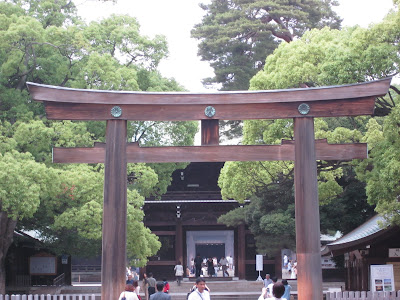
The main shrine gate, Otorii near the entrance.  It's 12 meters tall and has a 9.1 meter span in between the posts.  The wood was used from 1500 year old trees on Mt. Tandai in Taiwan.  It's the biggest wooden torii of this style in Japan. [11]   
The Torii leading up to the inner precincts of the shrine.  On it are 3 of the Imperial Seal, which is a chrysanthemum with 16 front and rear petals. 
The gate leading from the front entrance of the shrine to the inner precinct.
A picture of the courtyard inside the inner precinct.  The main building is behind me perpendicular to the main gate.

The previous pictures were taken during different visits, as our visit on New Year's Day was swarmed with people.  I heard the line to get to the shrine was over an hour through the main entrance, but luckily for us we went through the back of the shrine and entered through the West Entrance and only had to wait 15 minutes.

This entrance and line was a lot better than...
...
this one.
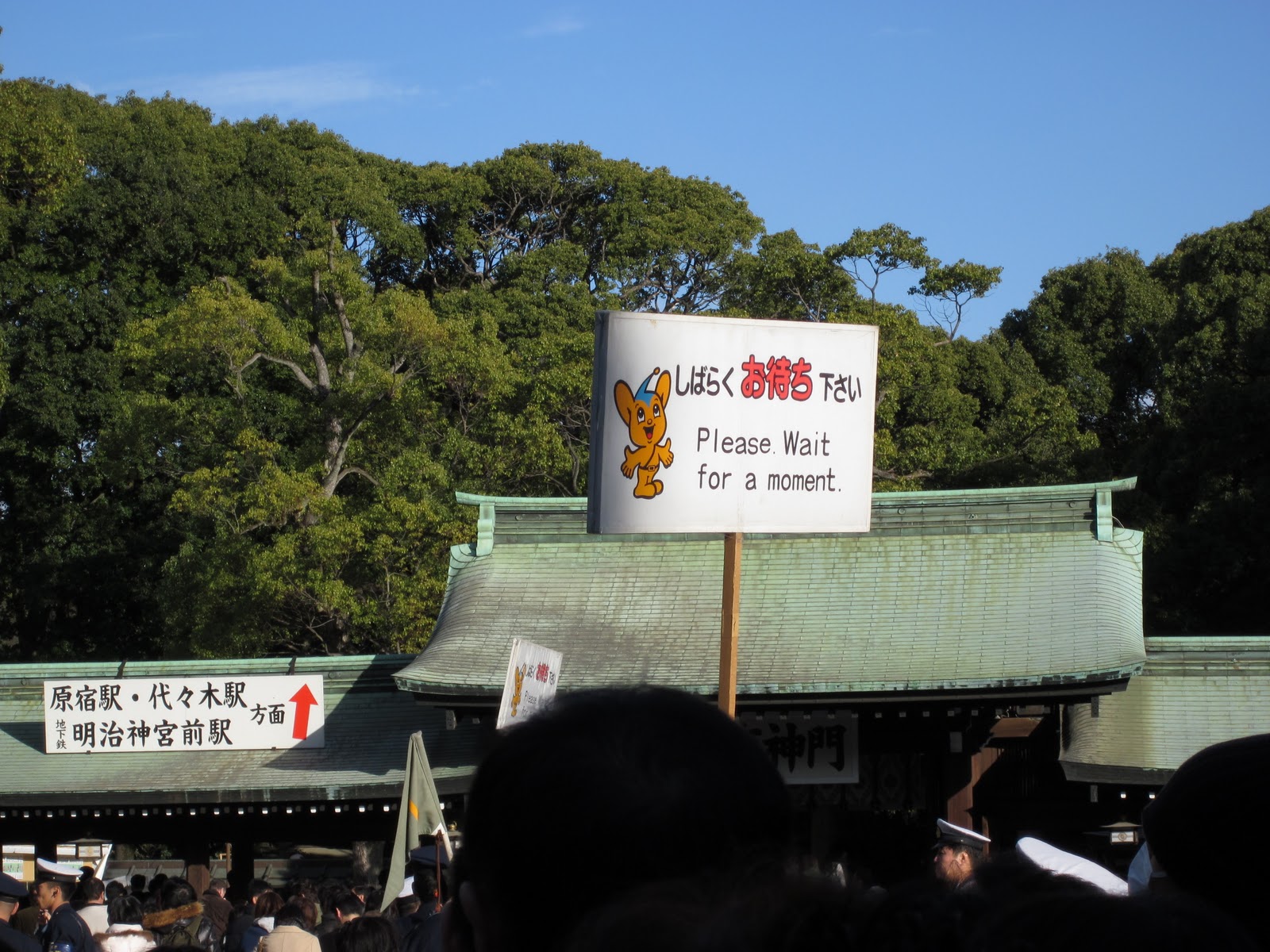
Lots of police on hand to guide people traffic and hold signs like this one, with the 'only in Japan' police's cute / ridiculous mascot.
The main shrine building during New Year's.
At the main shrine building, we made our wishes / prayers for the New Year.  For Shinto shrines this is done by first putting a small coin (5 or 10 yen) into the offertory box and afterwards, bowing twice, clapping twice, saying your wish or prayer and then bowing once more.  After doing this, we went over to see the New Year's stands selling the New Year shrine items.

Although due to the amount of people, the offertory box is swapped into an offertory tarp.  Basically you just get close enough to chuck your coin into the tarp area before wishing / praying.  (and yes, anything not white there is a multitude of coins)
Another common New Year's sight at shrines and often seen throughout the year are  food and drink offerings at the shrine.  Besides the mochi (on the right) that is offered to the gods, companies will give their products to the shrine to be offered to the gods for business success in the coming year.  Shrines often have sake at their shrines throughout the year, but on New Years you will also see Soy Sauce and even Coca-Cola products that look really out of place compared to the other goods.
The shrine stands selling all sorts of New Year's objects.  If you look closely in the top right,  you can see some of the objects for sale on the sign.  Many of the objects for sale relate to the zodiac animal for this year, the rabbit.
One of the shrine stands closer up, with a wide variety of New Year items for sale.
A stand just selling New Year's fortunes.

We didn't buy any objects at Meiji Jingū, but we did get our Goshuin signed for the New Year.


Being able to experience Meiji Jingū on New Year's was an incredible experience, but we weren't able to linger too long as we had more to see and do for New Year's day.  After finishing at Meiji Jingū, it was off to the next shrine to continue our New Year festivities at Hie Shrine.


References:

1. Ito Masami, "Osechi A New Year's Tradition That's Worth Celebrating," The Japan Times Online. November 23, 2003,
http://search.japantimes.co.jp/cgi-bin/fg20031121a1.html.

2. "Osechi Ryori (Japanese New Year's Food)," [No Recipes].
http://norecipes.com/blog/2010/01/02/osechi-ryori-japanese-new-years-food/.

3. Ito Masami, "Tales of New Year Tastes," The Japan Times Online. November 28, 2003,
http://search.japantimes.co.jp/cgi-bin/fg20031128a1.html.

4. "Osechi Ryori," [No Recipes].

5. Ito Masami, "Tales of New Year Tastes," The Japan Times Online.

6. Ibid.

7. "Osechi Ryori," [No Recipes].

8. "This Month's Highlights Previous Months," Meiji Jingu.
http://www.meijijingu.or.jp/english/highlights/2.html.

9. "About Meiji Jingu Meiji Jingu," Meiji Jingu.
http://www.meijijingu.or.jp/english/about/1.html.

10. Declan Murphy, "Meiji Jingu," The Yamasa Institute.
http://www.yamasa.org/japan/english/destinations/tokyo/meiji_jingu.html.

11. Ibid.