Rested from the previous night's festivities, people head out for the 2nd day of the festival in town. But before the dance is to continue again at night, there are many activities during the day this time to celebrate. Most of these revolve around the local shrine, Yoyogi Hachiman Shrine (代々木八幡宮, よよぎはちまんぐう). Yoyogi Hachiman Shrine is a Shinto (Japanese indigenous spiritualism) shrine. The shrine itself was made in 1212 by a member of the Genji clan as a branch of the famous Hachiman Shrine in Kamakura. [1] The Genji clan were in control of large parts of Japan during the early parts of the Kamakura Period (1185-1333). The period named after the government set up in the Genji clan's home of Kamakura. I will go into more detail and explanation about Kamakura, the Kamakura period and the Genji and Hōjō clans that were in power during this period in a future post when I talk about my trip to Kamakura. Hachiman is a god of war in Japan and the shrine here and in Kamakura are dedicated to this god. While it was the patron god of the Genji clan during the time of the Kamakura era, it developed into a local deity for the people of Yoyogi. [2] During the day of the festival there are many stands and events happening at the Yoyogi Hachiman Shrine.
Right next to the shrine entrance, you can see more of the lanterns and some of the stands that take over the shrine on the festival day. The one in front is selling bags of cotton candy I believe. The one on the left selling fried squid
(いかやき). いか meaning squid, and やき meaning fried.
The steps leading up to the entrance of the shrine. The entrance to Shinto Shrines always being marked by torii
(鳥居, とりい) or spiritual gates.
We ended up missing most of one of the main festivities for the day. On this day, Mikoshi are paraded through the town. Mikoshi (神輿, みこし) are portable Shinto shrines that carry divine spirits. These get brought out on festival days and paraded around town, carried on the shoulders from long wooden beam supports under the mikoshi.
Yoyogi Hachiman's Mikoshi (the large gilded building-like structure in the back). This is after the mikoshi is paraded through town and is on display at the shrine only on this day
Besides the parading of the mikoshi, the other main events on the day of the festival happen at the shrine, along with stands selling popular food and drinks, as well as traditional festival games.
The shrine, normally more closed than this, is open for special services and prayers on this day.
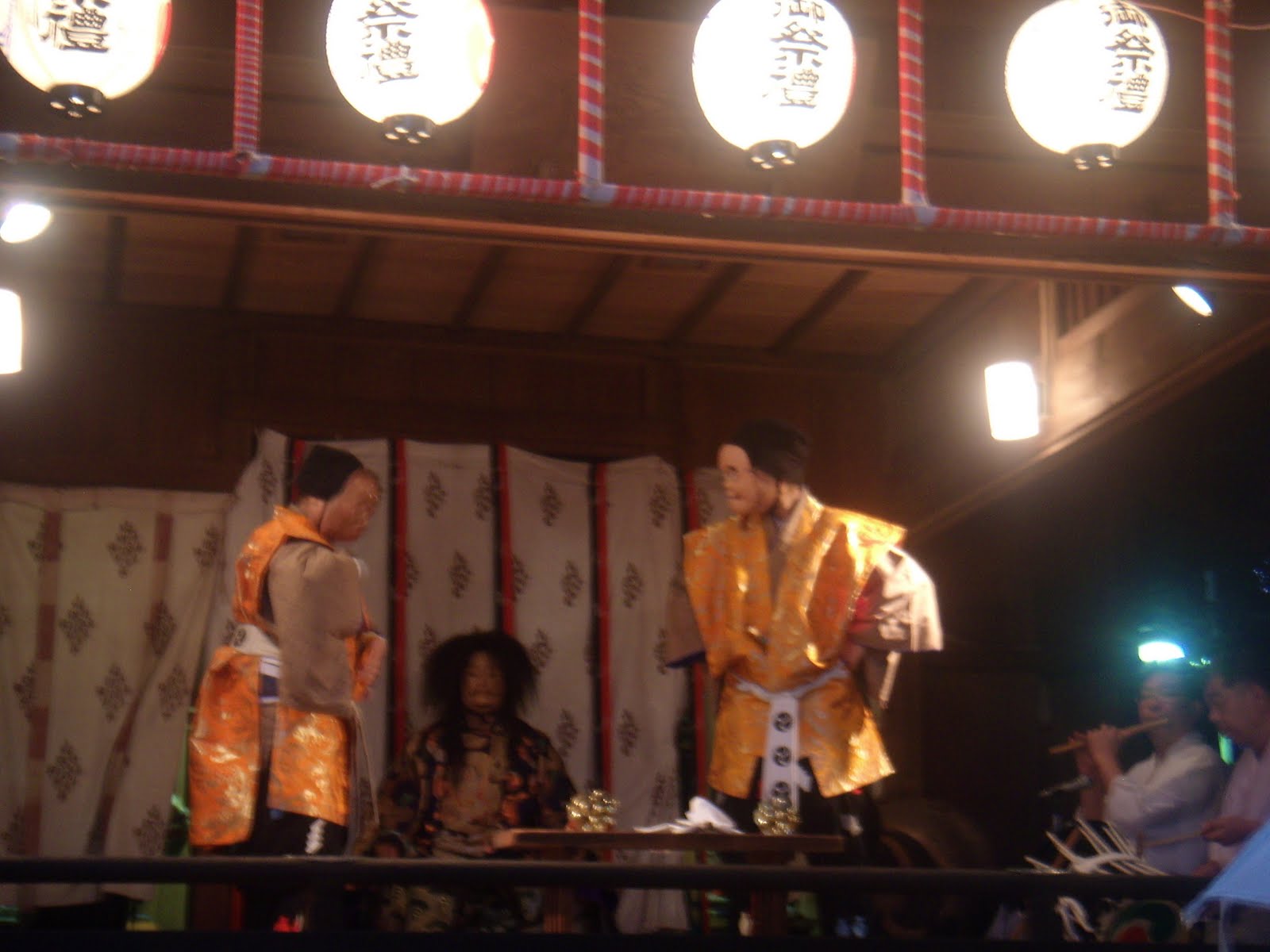
On the stage to the right of the shrine was a traditional performance.
Besides the various events, the shrine is packed with other stands selling various food and drink as well as traditional festival games to play.
Catching pets to bring home is a popular festival game.
Now for food and drink. Baked fresh water fish on a stick and a variety of tea and beer. Alcohol and religious institutions are not mutually exclusive here in Japan. In fact, for festivals it almost feels inclusive as lots of stands sell alcohol everywhere within the shrine.
Baked sweet potatoes.
Okonomiyaki and Takoyaki. Okonomiyaki (お好み焼き, おこのみやき) is a Japanese fried pancake / crepe with a variety of different ingredients depending on the region. The common ingredients are cabbage and batter, and then a variety of other ingredients, such as meats, vegetables and noodles can be added before baking. Okonomiyaki meaning okonomi (お好み, おこのみ), what you like and yaki, fried.
Takoyaki (タコヤキ) is octopus fried in a dough ball. Tako (蛸, たこ, タコ) being octopus and yaki (ヤキ) again being fried. The okonomiyaki stand is on the left, the takoyaki stand is on the right.
The glorious yakitori (焼き鳥, やきとり). A varitey of different meats fired on a stick, usually with two different flavors. The first being しお being salt flavor, and the second being しょうゆ, or soy sauce flavor. yaki meaning fried and tori
(鳥, とり) meaning bird meat, although other meats are used for yakitori).
After seeing so much food, we had to get some for ourselves. We got a variety of yakitori and some beer to go with it.
What is normally a quiet wooded area, becomes filled with the tents of stands on festival day.
With night quickly approaching we make our way back to town for the Awa Odori dance.
One last look back at the shrine.
The dancers getting ready before the start.
Unfortunately it rained the whole day and dampened the dancing a little bit on the second day.
This dancer had an inventive solution for the rain.
Unfortunately the rain had become too much on the 2nd night and the festival was cut short, only after an hour of dancing. Even though it was cut short, the 2 days of the festival were an incredible experience, one of the best I've had living in Japan. One of the things that stood out for me in the dance was how difficult it must be for the women who perform it. While it might not be obvious in the pictures and video I took, this is the stance for the female dancers the whole time.
The geta (下駄, げた), wooden sandals worn by the female dancers are tilted forward and towards the ground during the whole performance. The balance and stamina needed to dance in that stance for a few hours must be incredible making the dance much more impressive than at first glance.
The festival was an incredible experience and a lot of fun. The lyrics for the song of the Awa Odori dance are a good motto for the whole dance and festival itself.
"It's a fool who dances and a fool who watches! If both are fools, you might as well have fun dancing!" [3]
References:
1. Sumiko Enbutsu, "It's a Stroll in a Park to Find the Old Yoyogi," The Japan Times.
The neighborhood that I live in has their town's festival in September. Even though I've been to bigger festivals in bigger places, with everything involved it was right around the best competing with Nikko's Shunki Reitaisai. Although the march of a thousand samurai at that festival is difficult to match up with. The festival is the Awa Odori (阿波踊り) festival and revolves around the Awa Odori dance. The festival lasts for two days and involves a parade of the traditional dance each night, carrying mikoshi around town and stands and events at the local shrine.
The Awa Odori is a traditional dance in Japan that first developed in Tokushima Prefecture in Shikoku. There are a few stories about the original development of Awa Odori. The first is the dance was created as a celebration to the region's lord Hachisuga after the completion of the local castle in 1587, the 2nd being it was an adaptation of the Furyu dance that was the basis of Nō, traditional Japanese drama plays. The last being from the Bon dance, which is a traditional Japanese dance and holiday when people return to their hometowns to clean the graves of their ancestors and a day in Japanese Buddhism when the spirits of their ancestors return to the household altars. [1] Whatever the origins of the dance are, it has existed in Japan for over 400 years and was developed through the wealth of Indigo merchants in the area during the Meiji Era. [2] The name of the dance Awa Odori's meaning is, Awa being the old name for Tokushima Prefecture and Odori being dance.
For a few weeks before the event, the festival starts to come to life in the town as preparations get underway. These preparations around town are basically just hanging up hundreds of paper lanterns. As the time of the festival gets closer, more and more of the town is illuminated at night by the lanterns hanging above the street and the music of the dance starts to fill the evening air as the performers try to get extra practice in.
There are two places where the lanterns stand above the rest, the beginning of the main street through town and the local shrine. Here, the lanterns are lined up side by side, row on top of row creating a sea of red and white glowing papers. While these lanterns are the most impressive, they are also of a much more practical nature than the others.
The beginning of the main street here in town.
The local shrine the day of the festival.
The writing on these lanterns are the names of companies, local businesses and people who have donated money to the festival. In a way, they are giant traditional 'sponsored by' plaques. Certainly beats the typical boring board with plain font. With about a week to go before the festival, the lanterns are all up and everyone gets excited for the coming festival.
The name of the festival are the white lanterns. Directly below the first white lantern on the left is Smile (スマイル) which is the local drug store.
On the night of the festival, all of the excitement that has been building up finally gets put to use. The town transforms into a bustling lively place as the already narrow for a main street, street gets lined on both sides with tons of people waiting for the dance to come. The same dance is performed by many groups and each group lines up in order off to the side from the main street. Then the first group starts to play music from their traditional instruments in position and after a few measures of song kicks off their dance down the main street.
The starting point for the dancers.
The dancers wearing the traditional outfit of the Bon dance (specifically the ones with the hats being the typical full outfit).
The lead dancer for one of the dancing groups.
Some of the traditional instruments used in the dance.
The origins of this dance stems from a drunken celebration due to the completion of the castle with the local lord giving sake to the local residents. [3] I can see a glimpse into how it could have been from these two pictures.
The dance and spectators are not the only thing happening on the main street during the festival. All of the stores that sell food or drinks set up a stand outside their shop selling popular festival food and drinks to the spectators. The lanterns and bustle of people, many wearing traditional clothes eating and drinking festival favorites being hawked by the shops' small stands really fills the rest of the atmosphere for the dancing. The town becomes unrecognizable from its every day look.
Video of the 2nd day of the festival. This is one of the dancing groups that participate in the festival.
After a few hours of dancing, the dancers take one last pass down the street and at the end of the line, the spectators take their turn and join the dancing. After they reach the end, the dancers take their well deserved rest and the spectators slowly peter out; some dancing their way back home and some stumbling, but all return to their homes to rest for the next day of the festival and the dance.
References:
1. "Learn About the Koenji Awaodori More!," Tokyo Koenji Awa-Odori Association.
http://en.koenji-awaodori.com/more/.
2. Ibid.
3. "Awa-Odori Folk Dance Festival in Tokushima," Japan National Tourism Organization.
http://www.jnto.go.jp/eng/attractions/event/traditionalevents/a46_fes_awa.html.