I've also been thinking that the blog is a little too plain for a while now and had thought up some ideas on how to make things nicer and more appealing. The problem was my ideas would require me to draw them to make it happen. Put it all together and this is the start of it.
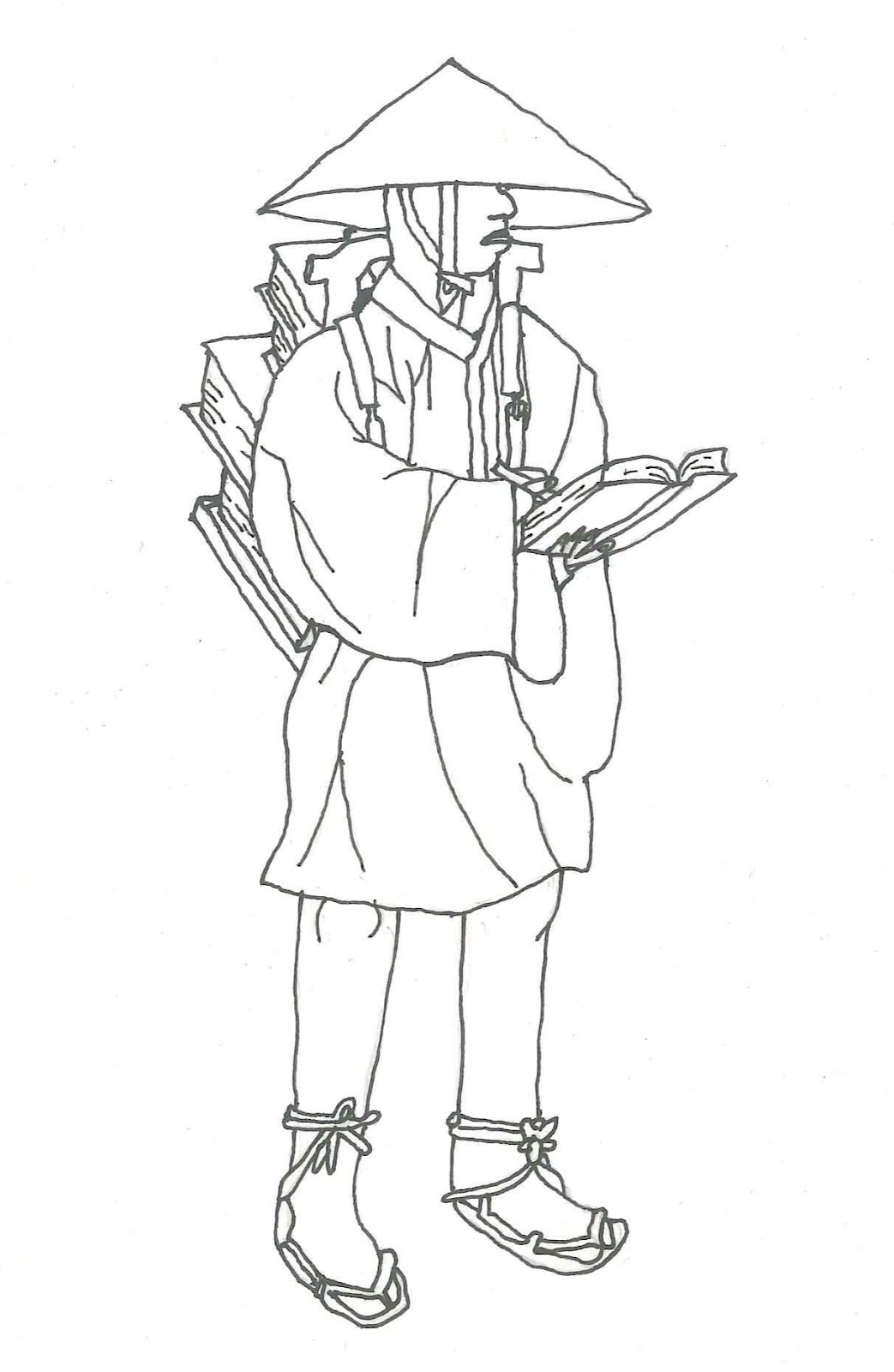
This is the logo for the blog that I've started. My two main artistic ideas I've been kicking around for a while now are a new blog header and a logo of some sort. I had wanted to create a nomadic chronicler based in a historical Japan setting to match with the blog and think it has turned out pretty well so far. The character is a combination of different historical traits to make it realistic, which I'll explain a bit for you here.
The main concept is a combination of a Japanese Buddhist monk with the famous historical person of Ninomiya Sontoku. Ninomiya Sontoku (二宮 尊徳) is a famous person in Japan who lived from 1787-1856 during the Edo Era. While his is a great story of a self-made man in Japan's past, unfortunately while looking for information about him the sources couldn't even past the low standards for source material in this blog. So I won't be able to include it now. Hopefully in the future I will find a suitable source or acquire a book that has the story and be able to write about it here.
For now, I'll just provide some basic background. He was born from a poor background and lost both of his parents at a young age. He then lived with an uncle and worked for him. He was basically completely self-taught, studying when he wasn't working for his uncle. He started by farming abandoned land and with the money was able to reacquire his family's land and grew rich, making him known for taking under-producing lands and make them profitable. His fame and success spread further as the local daimyo (lord) entrusted a district, domain and even a whole province to him to oversee, which also resulted in financial success. He was eventually given one of the Shogun's estates to oversee, an honor almost impossible due to his low beginnings. Sontoku was famous for not only his great success in agriculture and economics through being self-taught, but also for his high ethical principals that was a major part of his overall philosophy.
So by now you might be wondering how this Ninomiya Sontoku would become one of the main sources for the logo. You might be surprised then to find out there's a statue of him in schools all over Japan. In fact, before World War II all elementary schools had a statue of Ninomiya Sontoku who was upheld as a model of ethics and hard-work important during that era. However, many of the statues were taken late in the war to be melted down for armaments. While these days, the statue isn't a compulsory statue on school grounds and doesn't have the same propaganda or meaning from the past, it is still a popular symbol of hard work and the importance of studying. Here's how the statue looks all over the country.
 |
| This statue, similar to others all over Japan is at Hotokuninomiya-jinja near Odawara Castle where Ninomiya Sontoku is deified and enshrined. Odawara is the domain that he oversaw financial and economic matters. [1] |
Maybe now the connection is becoming clearer. Actually, I've seen this statute at many of the schools I've been to, but I never thought of the idea to use it for my drawing concept until I saw it in an advertisement. The statue of Ninomiya Sontoku was used in a recent e-reader advertising campaign, with him holding the e-reader instead of a book. It was a really well-done ad and for one of them, it showed his carrier full of books instead of firewood (suggesting the e-reader can hold many books much easier), which is what sparked the idea. Unfortunately, all of my attempts to find the picture or the ad have met with failure, so I can't show it here but the connections should be easy enough to see from the statue. While the character I made is obviously fictional, he's made up of traditional elements that could have been plausible to exist, that's if there ever would have been a nomadic chronicler in Japan's past (Bashō was a poet, so no he doesn't count.). I'll go over the parts that have some historical, realistic basis now for you.
I've been talking about Ninomiya Sontoku for a bit now, so I figured I'll switch things up and talk about the Buddhist monk elements first. During the Edo Era (which Ninomiya Sontoku lived in), travel was restricted between provinces. One of the few exceptions that were commonly granted was for pilgrimages. Pilgrimages have a long history in Japan and for a long time were the only form of recreational travel. Besides Bashō, these pilgrimages are the thing I think of when referring to anything nomadic in Japan.
For this character, the clothing is what is influenced by Buddhist monks. The robes are the traditional clothing for monks in Japan and the hat is worn by them while traveling. This hat is not just used by monks though. The hat is called a kasa (笠) and used to be worn by many people all throughout Japan. It can still be seen in rural and tradtional parts of Japan besides the monks who still wear them. This is because the kasa is the traditional umbrella of Japan. In fact, the hat kasa translates as umbrella or shade and is the same name for umbrella in Japanese, albeit different kanji: kasa (傘). For all of the clothing, this is how a Buddhist monk still looks like today and in the past.
As I'm sure you saw in the picture of Sontoku's statue, the items and posing were the main inspirations I drew for my drawing. Holding a book while walking is the most iconic part of the statue and shows Sontoku's perseverance and dedication by always reading and studying, even while working. To complete that part of the story from his childhood, he needs the maki katsugi (薪担ぎ), or firewood carrier. Ninomiya Sontoku, like many other people in traditional Japan used this to carry firewood from place to place. I replaced it with books like in the e-reader ad I saw to make it look more like he was carrying chronicles. My other change was to make him writing instead of reading as he's a chronicler. He's also using a pen, which is a modern object, but I wanted the chronicler to have some connection to the present as it's a blog.
This is now a finished draft for the logo and you might have noticed I've started putting it to use. I still have some more plans for it in the future. I will eventually get around to producing a shaded or colored version and plan on incorporating it into the blog header, which I already have an idea planned out for so be on the lookout for that as well. I also want to use it to make a watermark for the pictures that I include on the blog.
I've been going back and forth about whether to do this or not, but finally decided that it was a good idea to do it for blog. I'm sure that some people find the blog through an image search, grab the image and leave. For a long time I felt alright with this, as I also often don't have a picture I need and need to grab one off the web to be able to finish the post the way I wanted to. However, I at least always make sure to cite the pictures I take and include a link back to the post. If people don't do this though, then they're really just grabbing someone else's work without giving them any benefit. I would guess that I do more for the original poster than many people would do for pictures that they use from someone else. While I think it shouldn't be up to content creators to need to defend their works and should be the responsibility of people grabbing the image to do so properly and with credit, I also think the content creators have a right to try and retain some benefit out of their work.
As such, the goal isn't to punish or stop people from doing it, as I think both are not only impossible to do, but wouldn't be worth the time or effort even if I could. The goal is instead to try and gain some publicity even if the photos are used in an improper way. I will keep them small and out of the way for each picture, but big enough that people can get some information to find my blog. I also understand that people could just strip the watermark from the picture and then re-post it. But again, if someone knows how to and is going to spend the time to do that, then there's nothing I can do to stop that person that would be worth my time.
This is not to say that I condone these types of things happening. I think people should take the time to give credit for other's work and follow the requests for re-using it, especially if it is for financial or organizational gain. I will continue doing the same things I've been doing for other images I use and I think the watermark will even help this. I will not take ownership of anything I acquire from somewhere else and will not include the watermark on these images. Hopefully, this will also make it easier to distinguish which pictures are mine or someone else's. I also plan on writing some usage terms for this blog to make it easier and clearer for people wanting to use something from my blog. If anyone has any complaints about this or something to add to the debate, let me know as I'm still not 100% decided on this myself.
Hopefully, this will be the last of my posts about the workings of the blog for a while and I can get back to creating some more content, which I'm sure everyone is waiting for and I'm looking forward to get back to as well. Coming up are the interactive location map and the checklist I talked about in my previous post, and after that back to more travels with a tour of Tokyo's most famous temple, Senso-ji.
References:
1. "Hotoku Ninomiya Jinja Shrine," A Guide to Kamakura, http://www.asahi-net.or.jp/~qm9t-kndu/Ninomiya.htm.
I've been talking about Ninomiya Sontoku for a bit now, so I figured I'll switch things up and talk about the Buddhist monk elements first. During the Edo Era (which Ninomiya Sontoku lived in), travel was restricted between provinces. One of the few exceptions that were commonly granted was for pilgrimages. Pilgrimages have a long history in Japan and for a long time were the only form of recreational travel. Besides Bashō, these pilgrimages are the thing I think of when referring to anything nomadic in Japan.
For this character, the clothing is what is influenced by Buddhist monks. The robes are the traditional clothing for monks in Japan and the hat is worn by them while traveling. This hat is not just used by monks though. The hat is called a kasa (笠) and used to be worn by many people all throughout Japan. It can still be seen in rural and tradtional parts of Japan besides the monks who still wear them. This is because the kasa is the traditional umbrella of Japan. In fact, the hat kasa translates as umbrella or shade and is the same name for umbrella in Japanese, albeit different kanji: kasa (傘). For all of the clothing, this is how a Buddhist monk still looks like today and in the past.
As I'm sure you saw in the picture of Sontoku's statue, the items and posing were the main inspirations I drew for my drawing. Holding a book while walking is the most iconic part of the statue and shows Sontoku's perseverance and dedication by always reading and studying, even while working. To complete that part of the story from his childhood, he needs the maki katsugi (薪担ぎ), or firewood carrier. Ninomiya Sontoku, like many other people in traditional Japan used this to carry firewood from place to place. I replaced it with books like in the e-reader ad I saw to make it look more like he was carrying chronicles. My other change was to make him writing instead of reading as he's a chronicler. He's also using a pen, which is a modern object, but I wanted the chronicler to have some connection to the present as it's a blog.
This is now a finished draft for the logo and you might have noticed I've started putting it to use. I still have some more plans for it in the future. I will eventually get around to producing a shaded or colored version and plan on incorporating it into the blog header, which I already have an idea planned out for so be on the lookout for that as well. I also want to use it to make a watermark for the pictures that I include on the blog.
I've been going back and forth about whether to do this or not, but finally decided that it was a good idea to do it for blog. I'm sure that some people find the blog through an image search, grab the image and leave. For a long time I felt alright with this, as I also often don't have a picture I need and need to grab one off the web to be able to finish the post the way I wanted to. However, I at least always make sure to cite the pictures I take and include a link back to the post. If people don't do this though, then they're really just grabbing someone else's work without giving them any benefit. I would guess that I do more for the original poster than many people would do for pictures that they use from someone else. While I think it shouldn't be up to content creators to need to defend their works and should be the responsibility of people grabbing the image to do so properly and with credit, I also think the content creators have a right to try and retain some benefit out of their work.
As such, the goal isn't to punish or stop people from doing it, as I think both are not only impossible to do, but wouldn't be worth the time or effort even if I could. The goal is instead to try and gain some publicity even if the photos are used in an improper way. I will keep them small and out of the way for each picture, but big enough that people can get some information to find my blog. I also understand that people could just strip the watermark from the picture and then re-post it. But again, if someone knows how to and is going to spend the time to do that, then there's nothing I can do to stop that person that would be worth my time.
This is not to say that I condone these types of things happening. I think people should take the time to give credit for other's work and follow the requests for re-using it, especially if it is for financial or organizational gain. I will continue doing the same things I've been doing for other images I use and I think the watermark will even help this. I will not take ownership of anything I acquire from somewhere else and will not include the watermark on these images. Hopefully, this will also make it easier to distinguish which pictures are mine or someone else's. I also plan on writing some usage terms for this blog to make it easier and clearer for people wanting to use something from my blog. If anyone has any complaints about this or something to add to the debate, let me know as I'm still not 100% decided on this myself.
Hopefully, this will be the last of my posts about the workings of the blog for a while and I can get back to creating some more content, which I'm sure everyone is waiting for and I'm looking forward to get back to as well. Coming up are the interactive location map and the checklist I talked about in my previous post, and after that back to more travels with a tour of Tokyo's most famous temple, Senso-ji.
References:
1. "Hotoku Ninomiya Jinja Shrine," A Guide to Kamakura, http://www.asahi-net.or.jp/~qm9t-kndu/Ninomiya.htm.


