Showing posts with label Sakura. Show all posts

Tuesday, December 27, 2011

The Spring of Japan

Like in other places, spring is an exciting time to be in Japan.  The wide variety of gardens and plants that are planted and kept everywhere break out of their winter doldrums and splash color all over the landscape.  For many years, spring was the start of the New Year, as Japan followed the Chinese Lunar Calendar until 1872.  The weather starts to get warmer around March and this season is waited and watched for its blossoming seasons.  Spring also has some of the nicest weather of the year, before the rainy season in June and the oppressive heat and humidity of summer after that.

Spring was the traditional New Years in Japan, and while the date has changed to that of January 1st, much of Japanese society and culture is still rooted in this season being the one of change.  The school and fiscal year start in April.  March is the month when people say goodbye to the old.  This not only includes graduation ceremonies from schools, but the time when many people will change jobs.  In fact, many companies in Japan do most of their hiring in April for the start of the fiscal year, and it's an important time for college graduates to have their first job lined up already after graduating.

Spring is also the beginning of the blossoming seasons.  The blossoming seasons are one of the most exciting parts of spring, if not the most.  The most famous one is hanami, or the cherry blossom viewing of course, but before that are the ume blossoms.  These are the 2 most famous seasons these days and something I have already discussed with ume blossoms at Koishikawa Kōrakuen and at the Emperor's Palace; as well as cherry blossoms at Shinjuku Gyoen and at the Emperor's Palace.  These are the main seasons that people will watch, however other trees also have their own blossoming season.  Some of these trees had more significance in the past than now.  With the variety of blossoming trees being kept in various places throughout Japan, starting with the ume blossoms in February, for a few months one blossom season will transition right into the other.  The trees' blossoms even slightly overlap their blooming with the previous flower fading out right before the peak of the next season.  It creates a perfect balance of flowers on display throughout the whole of spring, which makes for an exciting and pretty time to be in Japan.  Here is the order of some of the common blossoms in the spring:


Ume (Plum, but really Japanese Apricot) (February - Early / Mid-March):


Ume Blossoms at Tochō, or Tokyo's City Government in Shinjuku. 


Mokuren (Lily Magnolia) (Mid-March - Early April):


Mokuren Blossoms in Shinjuku Gyoen.


Sakura (Cherry) (Late March - Early April):


Sakura Blossoms in Saitama Prefecture.


Momo (Peach) (Early April):


Momo Blossoms in Akita Prefecture. [1]


Hanamizuki (Dogwood) (Late April - Early May):


Hanamizuki Blossoms in Shibuya.


Some of the blossoms like the Sakura have viewing parties for them here in Japan.  The other ones people go to famous parks and spots where they are kept and people enjoy spring and the flowers during the short time they are here each year.  Some even get incorporated into seasonal foods.  One of my favorites is sakura ice cream, which is ice cream with cherry blossoms which creates a mild cherry flavor.  


Spring also has the longest set of National Holidays in Japan.  In the beginning of May there are 3 national holidays in a row, May 3rd, 4th and 5th.  These days will often combine with a weekend giving 5 days off in a row.  In Japan, this week is called Golden Week and many people travel during this time.  After Golden Week, all of the excitement from the spring settles down and people settle in to the new year.  Even spring at this point doesn't last too much longer as June brings the rainy season, the next season of the year here in Japan.


References:


1. Hidenori Hiruta, "Basho's Peach Blossoms," Akita International Haiku Network.
http://akitahaiku.wordpress.com/2009/06/14/bashos-peach-blossoms/.

Wednesday, July 13, 2011

Emperor's Cherry Blossoms (天皇の桜, てんのうのさくら, tennou no sakura)

Chidori ga Fuchi:


If you couldn't guess from the title, these cherry blossoms are all near the Emperor's Palace in Tokyo.  Mainly located in the northern area of the palace, many cherry blossom trees line the moat that surrounds this area.  As you could imagine for this area, the views during hanami are simply breathtaking as the paths and banks are covered in the light pink and white blossoms of the many trees in the area.  We went here on April 10th this year.

Leading up to Kitanomaru Park, which has the Budokan (the national martial arts hall).

Looking over the embankments on the Imperial Palace side.

Our simple hanami.
Lunch with a view.

The gate heading back out across the moat.

There was a place to rent boats to go around the moat, but the line like most popular things in Tokyo was incredibly long.  Maybe next year.


Starting our way around the moat.


The Budokan: Was made for the Judo arena during Japan's 1964 Olympics.  Besides martial arts, it is famous for hosting music concerts, most notably the Beatles' first concerts in Japan. [1]  


In the last entry, I explained a little about the importance of the cherry blossom in Japan's culture.  Maybe this next picture will look similar to the one above it.

Japan's 100 yen coin.  Worth about $1.20 now, but think of it as a Japan dollar bill equivalent.
One of the main coins uses the image of the sakura flower.  Japan uses coins only for 1, 5, 10, 50, 100 and 500 yen.  Being close to a dollar value, it is one of the most commonly used currency in Japan.  The portrait of Washington on the dollar bill getting replaced with cherry blossoms in Japan should give an idea of the cultural value the cherry blossom holds.

The end of the Sakura season brings the prettiest sight of the season, but also one with a twinge of sadness, as it marks the end of the cherry blossoms for that year.

桜吹雪: Cherry Blossom Blizzard (さくらふぶき, sakura fubuki)

Towards the end of the season, the trees start to lose a lot of their petals at once, especially when a breeze comes by.  All of the petals dropping makes the area look like it's snowing, even though it is just the cherry blossom petals.  It is by far the prettiest part of the cherry blossom season, but also bittersweet; for once they fall off the tree, that is it for the sakura until next year.


This transition from the blooming process, to full bloom and the final beauty of the sakura fubuki before disappearing for the year also has a significant cultural symbolism in Japan.  The great beauty of the cherry blossoms, tempered by its fragility and short blooming period of only a few weeks carries the symbolism of human's own mortality in Japan.  Drawing from Buddhism and early Japanese culture, this feeling of creating a bright beauty in the short time of life and then its bittersweet passing is a common motif in Japan culture and literature.  It never takes a stronger meaning than the cherry blossom season every spring.  While we would have gone to more places,  the cherry blossoms had all disappeared by the time the next weekend came.  This year it lasted from the end of March till early in April.  I'll have to wait for next spring to catch another glimpse of their brilliance here.

References:

1. Duncan, Bartlett, "Japan Keeps Lennon's Memory Alive," BBC.
http://news.bbc.co.uk/2/hi/entertainment/7770865.stm.

Monday, July 11, 2011

Cherry Blossom Season (花見, はなみ, hanami)

After everything that has happened this spring here, this was the event that could lift spirits.  While it took on a muted tone, because of the recent events; it was still an incredible time to be in Japan and have the opportunity to see it.  Hanami has been the thing I have most wanted to see in Japan that I hadn't seen yet.  I have been wanting to see it ever since not having the chance to see it during my  study abroad here.

Cherry Blossom: (桜, さくら, sakura)

Hanami is one of Japan's most significant cultural events.  It is so important that during the cherry blossom season, the news covers the spread of the cherry blossom blooming and predicted date of blooming throughout Japan as their main coverage.  The most common way of celebrating it is to get together with friends, family or co-workers and hanami, or basically picnic / party under the cherry blossom trees.  All across Japan, sakura trees can be spotted everywhere during this time with their delicate white, red and pink flowers filling the landscape.  There are many places in Japan that are specifically famous for their sakura and thousands of people flock to these spaces every spring.  My girlfriend showed me some of these famous spots in Tokyo and they blew away even my high expectations for it.  The sights are incredible and beautiful.  It's something I would recommend everyone to see at least once.

Shinjuku Gyoen:


This was the first place we went to to specifically see the cherry blossoms.  The garden was created on the old site of Daimyo Naito's residence in 1906 for use as an imperial garden. [1]  Destroyed in World War II, it was remade and turned into a public park.  It's 200 yen to enter the park, but well worth it during this season.  This trip was during April 3rd.  Hanami is usually late March to early April, lasting for only a few weeks.

One of the first scenes upon entering from Shinjuku Gate.  The cherry blossoms here mixed in with  what might be a magnolia tree.
The first pink blossoms along our way.
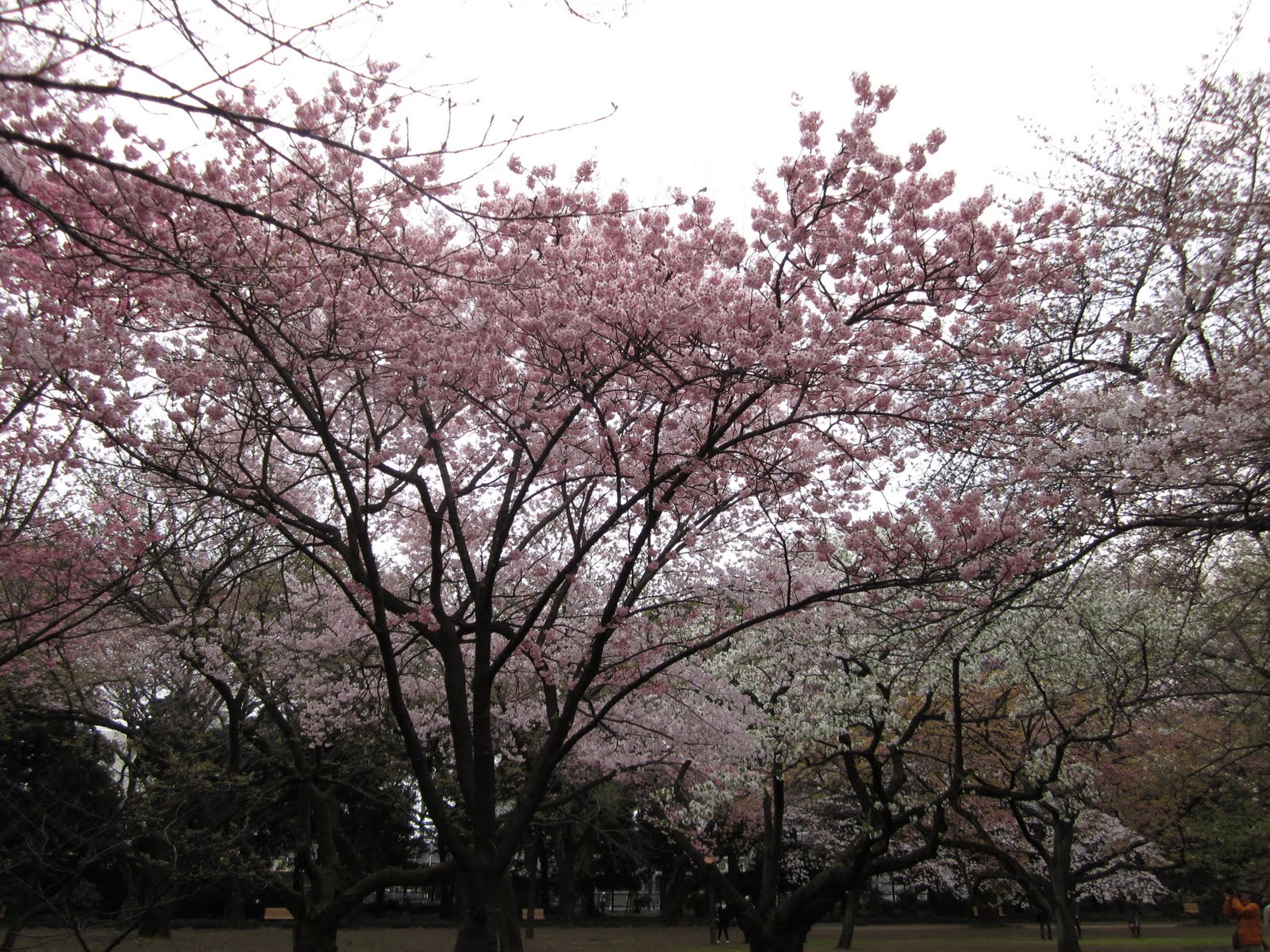
Something I learned this year is the prevalence of numerous types and colors of cherry blossoms.  Here's an interesting variety on the sakura shape.
Close-up of above.
Hanami in action.
I also learned sakura could be this bright red color and not just white or pink.
Close-up of above.
The prettiest section of the park for cherry blossoms.


The pictures can't really give the Cherry Blossom Season in Japan justice, but I hope you can get a taste of what it's like to be here during this time.  While Shinjuku Gyoen was incredible for hanami, there are even better spots in Tokyo for seeing the sakura and I will be showing these other areas that we went to next time.

References:

1. "Shinjuku Gyoen National Garden," Ministry of Environment (Japan).
http://www.env.go.jp/garden/shinjukugyoen/english/.