Showing posts with label Yoyogi Hachimangū. Show all posts

Sunday, January 15, 2012

The Festival of Goldfish

May 22nd, 2011:


Goldfish Mikoshi (portable shrine) at the Goldfish Festival.


Today we went to Kingyo Matsuri (金魚祭り), or Goldfish Festival at our neighborhood shrine of Yoyogi Hachiman (代々木八幡宮).  Every year the shrine holds this festival all about goldfish.  Goldfish for sale, goldfish games and even a portable shrine of a goldfish paraded through by children; the festival definitely matches its name.  Actually, this festival is based off a festival that existed in the area a century earlier.


In the early 1900s the area of Yoyogi had begun to develop.  At this time, people enjoyed having Kingyo (金魚), or goldfish in their garden ponds. [1]  During this time, there used to be goldfish sellers who would go to festivals to sell goldfish to people attending the festival.  One of the bigger festivals in Edo (present-day Tokyo) was and still is Kurayami Matsuri (くらやみ祭り), or Darkness Festival.  This interesting festival is held from April 30th to May 6th at Ōkunitama Jinja (大國魂神社) in Fuchū (府中) Tokyo.  Fuchū was an important post town on the Kōshū Kaidō (甲州街道), or one of the five important highways to Edo during the Edo period. [2]  Post towns were designated as rest areas for people traveling along these five main highways.  Many goldfish sellers would go to the Kurayami Matsuri and then return home along the Kōshū Kaidō.  The area of Yoyogi Hachiman was along the way back from the Kurayami Matsuri and many of the goldfish sellers tried to sell the leftover goldfish they had at the Goshagūsai Matsuri that was held here around the same time. [3]

This festival ended during the Taishō Era (1912-1926) , but Yoyogi Hachiman Shrine brought the festival back in 2003 due to local popular support to bring back the festival. [4]  The festival has been held every year since then and popular with the local neighborhoods.

The main building of Yoyogi Hachiman Shrine decorated with the banners and lanterns for Kingyo Matsuri.

One of the priests of the shrine going up to the Main Hall.  The Main Hall is only open on festival days.

Besides the Main Hall being open and the priests here, the shrine today has lots of goldfish.

Some of the goldfish being displayed for sale or used for games.

The festival still keeps the tradition of selling goldfish, and there are many stands with goldfish for sale.  More popular than the stands selling the goldfish were the ones holding the popular festival game involving goldfish called Kingyo-sukui (金魚すくい).

Kingyo-sukui, or 'Goldfish Scooping' is a traditional festival game that is still popular at Japanese festivals today.  The game has a small, long shallow tank filled with goldfish.  The participants take a Poi (ポイ), or paper scoop and scoop the goldfish from the tank into a tiny bowl.  When the Poi breaks and can no longer be used, the game is over and the person keeps all of the goldfish they were able to scoop into the bowl. [5]

A Kingyo-sukui stall during a festival along with the bowls and Poi.

With all of the goldfish at this festival and the popular Kingyo-sukui stalls about the shrine, this festival is especially popular with the children in the area and might be one of the reasons for its popularity and strong support among the local neighborhoods.  Even the local elementary schools make goldfish art and crafts that decorate the shrine grounds and the children lead the Goldfish Mikoshi procession that is the highlight of the festival.

The Goldfish Mikoshi on its way.

While not as big or impressive as the more famous festivals in Japan, it is a lot of fun and interesting to see the small local festivals that happen all over Japan.  It is especially great to get the chance to see the local festival of my own neighborhood's shrine.  These small festivals still have the local histories and cultures in focus and aren't distorted by the huge crowds and tourism that some of the larger festivals can't help to avoid.

References:

1. "年中行事," 八幡宮,
http://www.yoyogihachimangu.or.jp/11_event/index.html#event08.

2. Tadanao Noguchi, "Greetings From the Mayor," City of Fuchu,
http://www.city.fuchu.tokyo.jp/english/city/index.html.

3. "年中行事," 八幡宮.

4. Ibid.

5. Kaori, "I Wanna Scoop Baby," Shinjuku Daily Photo,
http://shinjukudailyphoto.blogspot.com/2011/12/i-wanna-scoop-baby.html.

Friday, October 21, 2011

First Afternoon and Evening (最初の午後と最初の夕方, さいしょのごごとさいしょのゆうがた, Saisho no gogo to saisho no yuugata)

The New Year's series of posts before this one: the basics of Japanese New Year's and some of its traditions here, New Year's Eve and Countdown here and New Year's sunrise, traditional meal and visit to Meiji Jingū here.


Our next Hatsumōde stop is at Hie Shrine (日枝神社, ひえじんじゃ).  Hie Shrine is in Nagata in the Chiyoda Ward of Tokyo.  It is actually very close to where I stayed during my time here as a study abroad student, but oddly enough I never visited the shrine during my time there and this would be my first visit.  


Hie Shrine has it's beginnings in the early Kamakura period (1185-1333) on the current site of the Emperor's Palace.  (I will be getting more into the history of Edo Castle and the Emperor's Palace in my next post, so if this is of interest then be on the lookout for it.)  A man named Edo had built a Hie Shrine here to house the guardian deity of his property.  The deity in Hie Shrines is Ōyamakui-no-kami, which is the God of Mt. Hie in Shiga Prefecture; it is more commonly known as Hie-no-kami. [1]  Shiga Prefecture can be found on the 4th map of my Maps of Japan post.  Ōyamakui-no-kami is the master of the great mountain and look over the growth of everything, especially business. [2]  Hie Shrine's next development would come in 1478 when Ota Dokan built Edo Castle in the same spot and built Sanno-Hie Shrine to house the guardian deity for the castle.  When Iyeasu Tokugawa took over Edo Castle to rule over Edo and Japan as Shogun, he also gave patronage to the shrine and made it a protector of the city of Edo.  Now the guardian deity of the Shogun,  it greatly increased the importance of Hie Shrine and its following from the local people. [3]


Hidetada Tokugawa, 2nd Shogun of the Tokugawa Shogunate moved the shrine in 1607 to near the present day National Theater instead of inside the castle grounds, because citizens of Edo could only visit the shrine two days of the year while it was in the castle grounds.  However this didn't last long as the shrine burned down in a fire along with most of the city in 1657.  When it was rebuilt in 1659, the shrine was moved to its current location.  These shrines buildings were designated as national treasures until they were unfortunately also lost to fire, this time to the air raids of World War II.  The present shrine was rebuilt in 1958 with donations from worshipers of the shrine. [4]


While Hie Shrine is not the most famous of shrines for Hatsumōde, my girlfriend suggested we go because of their wide variety of New Year's Ema for sale.  I have talked previously about ema and collecting them, when I talked about my trip to Enoshima and buying the ema here.  Before the ema, I'll show the shrine experience up to that point.  


The torii leading up to Hie Shrine.  The shrine is on top of the hill in the area, so there are a lot of steps to the top.
The main building of Hie Shrine decorated for New Year's.
Looking back at the entrance of the inner gate.
The statues of two monkeys line the main gate to the shrine.  The monkey is the messenger for  the shrine's god.  These messengers are called masaru (monkey is saru in Japanese) and a play off this word of masaru is ma ga saru, meaning to take a charm to ward off evil.  Monkeys are also considered good luck for childbirth, child rearing and marriage happiness due to their perceived affection towards children. [5]


We actually didn't make our wishes or pray at this shrine as the line was very long (over an hour wait) and there were no back ways in like Meiji Jingū.  We were also running out of time in the day and still had things to do.  However, we did participate and watch several of the New Year's festivities at the shrine.


Shrines often serve a special sake for the New Year's celebration.  This sake is amazake, and is a sweet sake served at shrines for the New Year's holiday.  It was really cheap and certainly worth every yen, as it was delicious.   
Speaking of sake, here is the sake offerings given to Hie Shrine.  This is what the sake offerings usually look like, with a full cask given.  This is actually a very common sight at shrines.
We also watched this ceremony at the shrine.  The shrine maiden takes the protection charms that the worshipers have bought from the shrine and then prays to the gods for extra protection from them.
After seeing the typical New Year celebrations from the shrine, we set out to do what we planned on doing at the shrine.  First, we set out to buy the New Year's Ema.  


Hie Shrine has so many ema that they put out a big bulletin board with all of the ema and a number below them so people can look first and then give the number to the counter when they are ready to buy them.
A closer view of the smaller ema.


As you can see, almost all of the ema have rabbits on them.  That's because this is the year of the rabbit (usagi in Japanese, うさぎ).  Japan still puts importance in the Chinese Zodiac and it's animals.  The rotation for the Zodiac is:


2010: Tiger (寅, とら, Tora)
2011: Rabbit (卯, う, U)
2012: Dragon (辰, たつ, Tatsu)
2013: Snake (巳, み, Mi)
2014: Horse (午, うま, Uma)
2015: Sheep (羊, ひつじ, Hitsuji)
2016: Monkey (申, さる, Saru)
2017: Rooster (酉, とり, Tori)
2018: Dog (戌, いぬ, Inu)
2019: Boar (Pig in Chinese) (亥, い, I)
2020: Rat (子, ね, Ne)
2021: Ox (丑, うし, Ushi)


Here are the ema I picked up from Hie Shrine:


The last thing to do at Hie Shrine was to get the New Year's Goshuin.


Our last stop of the day was to our local neighborhood shrine of Yoyogi Hachiman for Hatsumōde.  I talked about my local shrine before during the neighborhood Awa Odori Festival.  Even though the New Year festivities were much smaller at this shrine, being the neighborhood shrine made the event as special as any of the other shrines we visited during the day.


The shrine lit by New Year's lanterns.


While it might seem like this was really late in the day, we arrived there early evening.  Japan's sunrise and sunset are both very early and with no Daylight's Savings Time like in the US, it gets dark here pretty early during the winter.


A closer picture of the lanterns set up at the entrance.
This ring of bound grasses is used at shrines for the new year to clean the body of bad luck or bad things accumulated throughout the previous year.
The main hall decorated for New Year's.  The bells on the rope are rung by the worshipers to let the gods at the shrine know the people are there before making their wish and prayers for the New Year.


After making our wishes and prayers for the New Year, we went to get the New Year's Goshuin from the shrine.


After getting the Goshuin, we returned home ending our festivities for New Year's Day.  There was so much to do, and I was glad to be able to experience all of the amazing things that the New Year's holiday has to offer in Japan.  I look forward to the holiday next year and participating in the same things again, and maybe trying some new traditions for New Year's too.


References:


1. "Brief History of Hie Jinja," Hie Jinja.
http://www.hiejinja.net/jinja/english/history.html.


2. Terue Kawai, "Shrines - Bastions for the Japanese Heart and Soul Down Through the Ages," Marunouchi.com. 
http://www.marunouchi.com/e/interview/marunouchi2011_11_01.html.


3. "Brief History," Hie Jinja.


4. Terue Kawai, "Shrines - Bastions for the Japanese Heart and Soul," Marunouchi.com.


5. Ibid.

Monday, July 18, 2011

Lost Chronicles: Awa Odori Day 2 (失われた編年史: 阿波踊りの二日, うしなわれたへんねんし: あわおどりのふつか)

Sept. 23rd, 2010:

Rested from the previous night's festivities, people head out for the 2nd day of the festival in town.  But before the dance is to continue again at night, there are many activities during the day this time to celebrate.  Most of these revolve around the local shrine, Yoyogi Hachiman Shrine (代々木八幡宮, よよぎはちまんぐう).  Yoyogi Hachiman Shrine is a Shinto (Japanese indigenous spiritualism) shrine.  The shrine itself was made in 1212 by a member of the Genji clan as a branch of the famous Hachiman Shrine in Kamakura. [1]  The Genji clan were in control of large parts of Japan during the early parts of the Kamakura Period (1185-1333).  The period named after the government set up in the Genji clan's home of Kamakura.  I will go into more detail and explanation about Kamakura, the Kamakura period and the Genji and Hōjō clans that were in power during this period in a future post when I talk about my trip to Kamakura.  Hachiman is a god of war in Japan and the shrine here and in Kamakura are dedicated to this god.  While it was the patron god of the Genji clan during the time of the Kamakura era, it developed into a local deity for the people of Yoyogi. [2]  During the day of the festival there are many stands and events happening at the Yoyogi Hachiman Shrine.

Right next to the shrine entrance, you can see more of the lanterns and some of the stands that take over the shrine on the festival day.  The one in front is selling bags of cotton candy I believe.  The one on the left selling fried squid
(いかやき).  いか meaning squid, and やき meaning fried.

The steps leading up to the entrance of the shrine.  The entrance to Shinto Shrines always being marked by torii
(鳥居, とりい) or spiritual gates.

We ended up missing most of one of the main festivities for the day.  On this day, Mikoshi are paraded through the town.  Mikoshi (神輿, みこし) are portable Shinto shrines that carry divine spirits.  These get brought out on festival days and paraded around town, carried on the shoulders from long wooden beam supports under the mikoshi.

Yoyogi Hachiman's Mikoshi (the large gilded building-like structure in the back).  This is after the mikoshi is paraded through town and is on display at the shrine only on this day

Besides the parading of the mikoshi, the other main events on the day of the festival happen at the shrine, along with stands selling popular food and drinks, as well as traditional festival games.

The shrine, normally more closed than this, is open for special services and prayers on this day.

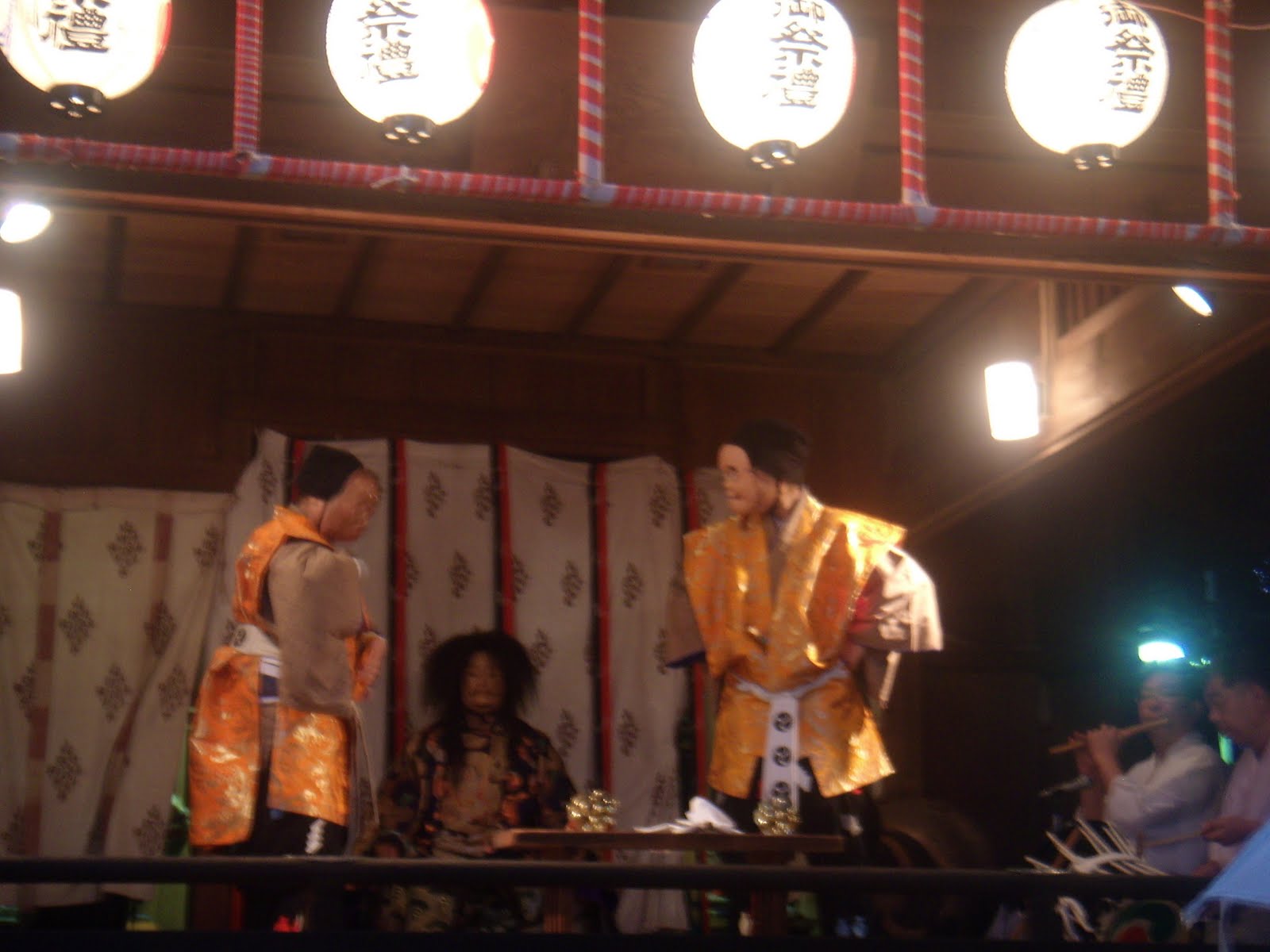
On the stage to the right of the shrine was a traditional performance.


Besides the various events, the shrine is packed with other stands selling various food and drink as well as traditional festival games to play.

Catching pets to bring home is a popular festival game.


Now for food and drink.  Baked fresh water fish on a stick and a variety of tea and beer.  Alcohol and religious institutions are not mutually exclusive here in Japan.  In fact, for festivals it almost feels inclusive as lots of stands sell alcohol everywhere within the shrine.  

Baked sweet potatoes.

Okonomiyaki and Takoyaki.  Okonomiyaki (お好み焼き, おこのみやき) is a Japanese fried pancake / crepe with a variety of different ingredients depending on the region.  The common ingredients are cabbage and batter, and then a variety of other ingredients, such as meats, vegetables and noodles can be added before baking.  Okonomiyaki meaning okonomi (お好み, おこのみ), what you like and yaki, fried.

Takoyaki (タコヤキ) is octopus fried in a dough ball.  Tako (蛸, たこ, タコ) being octopus and yaki (ヤキ) again being fried.  The okonomiyaki stand is on the left, the takoyaki stand is on the right.   

The glorious yakitori (焼き鳥, やきとり).  A varitey of different meats fired on a stick, usually with two different flavors.  The first being しお being salt flavor, and the second being しょうゆ, or soy sauce flavor.  yaki meaning fried and tori
(鳥, とり) meaning bird meat, although other meats are used for yakitori).

After seeing so much food, we had to get some for ourselves.  We got a variety of yakitori and some beer to go with it.

What is normally a quiet wooded area, becomes filled with the tents of stands on festival day.

With night quickly approaching we make our way back to town for the Awa Odori dance.

One last look back at the shrine.

The dancers getting ready before the start.


Unfortunately it rained the whole day and dampened the dancing a little bit on the second day.

This dancer had an inventive solution for the rain.

Unfortunately the rain had become too much on the 2nd night and the festival was cut short, only after an hour of dancing.  Even though it was cut short, the 2 days of the festival were an incredible experience, one of the best I've had living in Japan.  One of the things that stood out for me in the dance was how difficult it must be for the women who perform it.  While it might not be obvious in the pictures and video I took, this is the stance for the female dancers the whole time.

The geta (下駄, げた), wooden sandals worn by the female dancers are tilted forward and towards the ground during the whole performance.  The balance and stamina needed to dance in that stance for a few hours must be incredible making the dance much more impressive than at first glance.
The festival was an incredible experience and a lot of fun.  The lyrics for the song of the Awa Odori dance are a good motto for the whole dance and festival itself.

"It's a fool who dances and a fool who watches! If both are fools, you might as well have fun dancing!" [3]


References:

1. Sumiko Enbutsu, "It's a Stroll in a Park to Find the Old Yoyogi," The Japan Times.
http://search.japantimes.co.jp/cgi-bin/fe20041203se.html.

2. Ibid.

3. "Awa-Odori Folk Dance Festival in Tokushima," Japan National Tourism Organization.
http://www.jnto.go.jp/eng/attractions/event/traditionalevents/a46_fes_awa.html.